
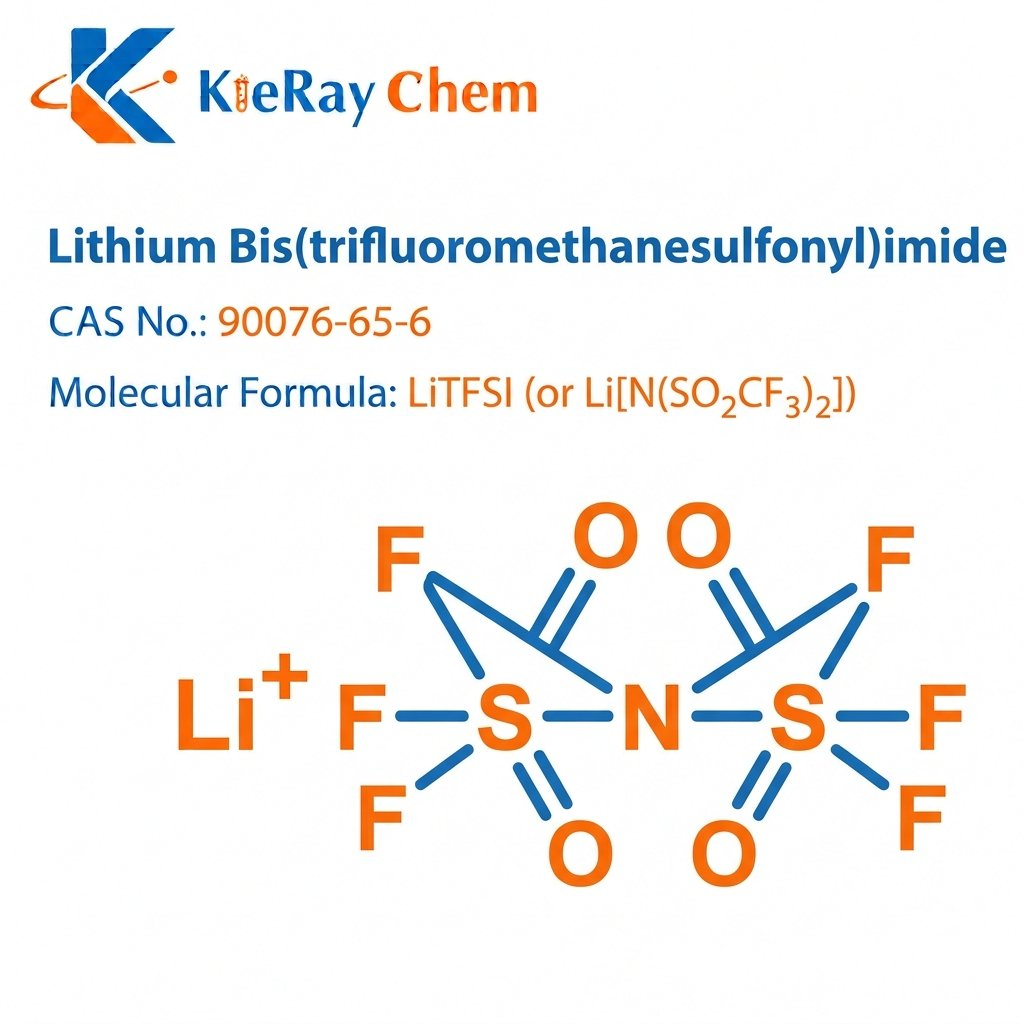
Lithium Bis(trifluoromethanesulfonyl)imide
Lithium Bis(trifluoromethanesulfonyl)imide (CAS:90076-65-6), widely known as LiTFSI, is a benchmark electrolyte salt renowned for outstanding thermal, chemical and electrochemical stability. The weakly coordinating imide anion delivers exceptional ionic conductivity, low viscosity and superior resistance to hydrolysis and oxidation, making LiTFSI essential for advanced lithium batteries, lithium-metal batteries, supercapacitors and solid-state electrolyte research. As a Battery Grade product, this material is manufactured with defined process control and released against documented specifications covering assay, impurities and physical properties, which simplifies incoming inspection for buyers. Flexible packaging options including 25kg/drum, IBC Drum and dependable export logistics make volume sourcing straightforward, while consistent quality protects downstream process reproducibility and end-product performance.
KieRay Chem has established itself as a stable and trustworthy supplier of Lithium Bis(trifluoromethanesulfonyl)imide (CAS:90076-65-6), combining years of manufacturing experience with rigorous quality management. Every batch is tested against tight specifications for assay, impurities and physical properties, and complete COA, technical data sheets and safety documentation are provided with each shipment. Our flexible packaging options, dependable global logistics and responsive technical support ensure that research laboratories, formulators and industrial manufacturers receive consistent material on schedule. Competitive pricing, long-term stock availability and the ability to tailor grades and pack sizes make KieRay Chem the partner of choice for sustaining uninterrupted production and product quality.
## Lithium Bis(trifluoromethanesulfonyl)imide (LiTFSI, CAS 90076-65-6): Key Functions and Uses
1. **High-Performance Lithium Battery Electrolyte Salt**
Lithium Bis(trifluoromethanesulfonyl)imide, commonly known as **LiTFSI**, is a widely studied lithium salt for liquid, gel, polymer, and solid-state electrolyte systems. It provides mobile lithium ions for charge transport between battery electrodes.
2. **Lithium-Ion Battery Electrolyte Development**
LiTFSI is used in advanced lithium-ion battery research, including lithium-metal, silicon-anode, lithium–sulfur, and high-energy-density cell designs. Its high solubility and strong ionic dissociation can support effective electrolyte conductivity.
3. **High-Voltage and Thermal-Stability Research**
Compared with some conventional lithium salts, LiTFSI is valued for its favorable thermal stability and broad electrochemical operating range. It is therefore investigated for high-voltage cells, high-temperature operation, and safer next-generation energy-storage technologies.
4. **SEI and Interfacial Film Formation**
LiTFSI can participate in the formation of solid electrolyte interphase (SEI) layers on lithium, graphite, and silicon-based anodes. Properly designed interfacial films may reduce unwanted electrolyte decomposition and improve cycling stability.
5. **Solid-State and Polymer Electrolytes**
LiTFSI is an important salt for polymer electrolytes, including PEO-based systems, gel electrolytes, and composite solid electrolytes. It can improve lithium-ion availability and support research into flexible, nonflammable, and high-performance battery architectures.
6. **Ionic-Liquid and Supercapacitor Research**
LiTFSI is used in ionic-liquid electrolytes, hybrid electrolyte systems, supercapacitors, and other electrochemical devices. Its compatibility with selected ionic liquids and organic solvents makes it useful for studying ion transport, electrochemical stability, and energy-storage performance.
7. **Solar Cells and Advanced Electrochemical Devices**
LiTFSI may serve as a lithium-ion source or electrolyte additive in dye-sensitized solar cells, perovskite-related research, electrochemical sensors, and other functional devices. Application-specific testing is required to confirm compatibility and long-term stability.
8. **Quality, Procurement, and Safety Considerations**
When sourcing Lithium Bis(trifluoromethanesulfonyl)imide 90076-65-6, buyers should verify battery-grade purity, water content, halide and metal impurities, thermal properties, packaging, certificate of analysis, and storage requirements. Useful SEO keywords include **Lithium Bis(trifluoromethanesulfonyl)imide, LiTFSI, CAS 90076-65-6, lithium battery electrolyte, solid-state electrolyte, polymer electrolyte, lithium-metal battery, lithium–sulfur battery, and ionic-liquid electrolyte**. Users should follow the supplier’s Safety Data Sheet and consider material compatibility, including possible corrosion of aluminum current collectors under certain conditions.
Product Name: Lithium Bis(trifluoromethanesulfonyl)imide
For global customers, we provide complete technical documentation to support product evaluation, regulatory compliance and safe handling during transportation and application.