
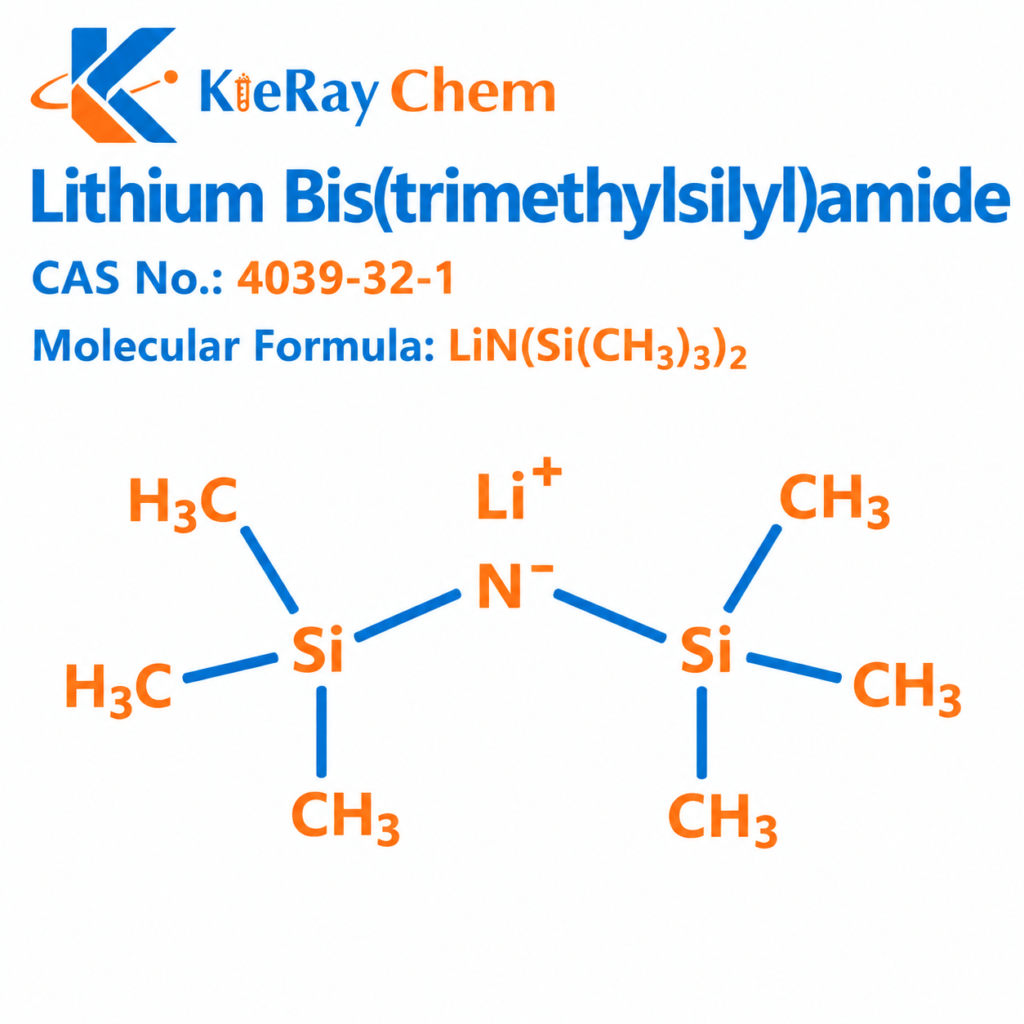
Lithium Bis(trimethylsilyl)amide
Lithium Bis(trimethylsilyl)amide (CAS:4039-32-1), commonly known as LiHMDS, is a strong, non-nucleophilic Brønsted base widely soluble in nonpolar organic solvents. It is the reagent of choice for enolate formation, regioselective deprotonations and the synthesis of complex natural products and pharmaceutical intermediates, delivered as solids or standardized THF solutions. With its Industrial Grade designation, every lot carries a complete certificate of analysis including assay, purity and physical data, giving QC teams everything needed for release testing. The product is backed by flexible 25kg/drum, 200kg/drum packaging, steady stock availability and export documentation, so customers can plan procurement with confidence and keep production running without interruption.
KieRay Chem is recognized as a reliable partner for Lithium Bis(trimethylsilyl)amide (CAS:4039-32-1), with dedicated production capacity, strict process control and a proven global track record. Batch-to-batch reproducibility is guaranteed by standardized production and full QC release, with COA, technical datasheets and safety files delivered with every order. Customized grades, pack sizes and dependable delivery schedules help customers maintain uninterrupted production and end-product quality worldwide. With a strong export record and customer-first service, KieRay Chem ensures every tonne of product meets the highest standards of purity and safety.
## Lithium Bis(trimethylsilyl)amide (CAS 4039-32-1): Key Functions and Uses
1. **Strong, Non-Nucleophilic Base**
Lithium Bis(trimethylsilyl)amide, commonly known as **LiHMDS or LHMDS**, is a strong and relatively non-nucleophilic organolithium base. It is widely used when efficient deprotonation is required without significant direct nucleophilic attack on the substrate.
2. **Enolate and Carbanion Generation**
One of its primary functions is the controlled generation of **enolates, carbanions, and other lithium intermediates** from suitable organic compounds. These reactive species are important tools for carbon–carbon bond formation and selective functional-group transformation.
3. **Applications in Organic and Medicinal Chemistry**
LiHMDS supports advanced organic synthesis, medicinal chemistry, pharmaceutical intermediate development, and agrochemical research. It can be used in alkylation, acylation, condensation, cyclization, and other reactions that depend on precise base-mediated activation.
4. **Improved Reaction Control and Selectivity**
Under appropriate conditions, Lithium Bis(trimethylsilyl)amide can help control reaction temperature, stoichiometry, solvent effects, and enolate formation. This makes it useful for investigating regioselectivity, stereoselectivity, reaction mechanisms, and synthetic route optimization.
5. **Low-Temperature and Process Chemistry Applications**
LiHMDS is often selected for reactions performed at low or controlled temperatures, particularly when sensitive intermediates must be generated and consumed in situ. It can support laboratory-scale process development and the preparation of complex, high-value molecules.
6. **Use in Materials and Organometallic Research**
This reagent may also be used in organometallic chemistry, functional materials research, and the preparation of specialized intermediates. Its strong basicity and compatibility with selected aprotic solvents make it valuable for developing tailored synthetic methods.
7. **Quality and Procurement Considerations**
When sourcing Lithium Bis(trimethylsilyl)amide 4039-32-1, buyers should verify concentration, solvent, purity, water content, packaging, batch consistency, certificate of analysis, and storage requirements. Relevant search terms include **LiHMDS, LHMDS, lithium hexamethyldisilazide, strong non-nucleophilic base, organolithium reagent, and CAS 4039-32-1**.
8. **Professional Handling and Safety**
LiHMDS is moisture-sensitive and highly reactive. It may react with water or humid air and can present fire, chemical, and exposure hazards. It should be handled only by trained professionals under appropriate inert-atmosphere procedures, in accordance with the supplier’s Safety Data Sheet, institutional protocols, and applicable regulations.
Product Name: Lithium Bis(trimethylsilyl)amide
For global customers, we provide complete technical documentation to support product evaluation, regulatory compliance and safe handling during transportation and application.