
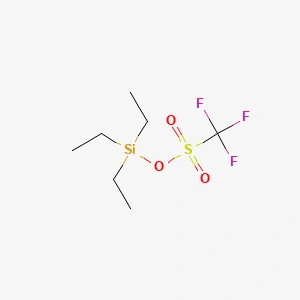
Triethylsilyl trifluoromethanesulfonate
Triethylsilyl trifluoromethanesulfonate (CAS 79271-56-0), frequently referred to as TESOTf, is a highly reactive organosilicon reagent that serves as a cornerstone in modern organic synthesis. Characterized as a colorless to light yellow fuming liquid, this compound functions as both a powerful electrophilic silylating agent and a potent Lewis acid. Its chemical profile is defined by the triflate leaving group, which imparts significantly higher reactivity compared to corresponding silyl chlorides. Due to its extreme sensitivity to moisture, TESOTf requires specialized handling under anhydrous conditions and inert atmospheres, such as nitrogen or argon, to prevent rapid hydrolysis and the generation of corrosive trifluoromethanesulfonic acid. In industrial research and fine chemical production, it is valued for its ability to mediate complex transformations and introduce protecting groups with high efficiency, making it an essential component in the synthesis of sophisticated molecular frameworks, including natural products and pharmaceutical intermediates.
• Silyl Protecting Group Installation: TESOTf is widely utilized for the protection of alcohols, phenols, and carboxylic acids as triethylsilyl (TES) ethers or esters. The TES group provides a unique stability profile, being more robust than trimethylsilyl (TMS) groups while remaining more labile than tert-butyldimethylsilyl (TBS) groups, which facilitates orthogonal protection strategies in multi-step organic synthesis.
• Generation of Enol Silyl Ethers: The reagent is highly effective for the conversion of carbonyl compounds, such as ketones and aldehydes, into triethylsilyl enol ethers. These intermediates are vital for subsequent carbon-carbon bond-forming reactions, including Mukaiyama aldol additions and various alkylation processes, often proceeding under milder conditions than those required by less reactive silylating agents.
• Lewis Acid Catalysis and Activation: TESOTf acts as a versatile Lewis acid catalyst in numerous chemical transformations. It is frequently employed to promote glycosylation reactions, the opening of epoxides, and the activation of acetals or ketals for nucleophilic attack. Its high oxophilicity allows for the precise activation of oxygenated functional groups in the synthesis of complex polycyclic molecules.
• Specialized Synthetic Transformations: Beyond standard protection, the reagent is used in the synthesis of nucleoside analogs and the rearrangement of sensitive molecular scaffolds. Its ability to facilitate selective transformations under low temperatures makes it indispensable for the construction of thermally unstable or sterically hindered chemical species.
Product Name: Triethylsilyl trifluoromethanesulfonate
For global customers, we provide complete technical documentation to support product evaluation, regulatory compliance and safe handling during transportation and application.