
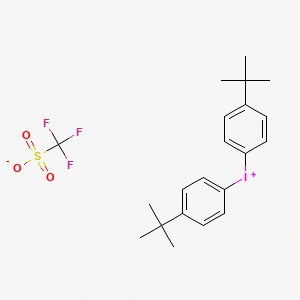
Bis(4-tert-butylphenyl)iodonium triflate
Bis(4-tert-butylphenyl)iodonium triflate, identified by CAS number 84563-54-2, is a high-performance diaryliodonium salt widely utilized as a photoacid generator (PAG) in advanced chemical processing. Characterized by its trifluoromethanesulfonate (triflate) anion and tert-butyl substituted phenyl groups, this compound exhibits excellent thermal stability and superior solubility in various organic monomers and solvent systems compared to unsubstituted analogs. In the presence of ultraviolet radiation or electron beam exposure, it undergoes photolysis to release a strong Brønsted acid (triflic acid), which serves as a potent catalyst for chemical transformations. As a chemical raw material, it is valued for its high sensitivity and efficiency in initiating cationic reactions. Proper handling requires protection from light and moisture to maintain its reactivity and prevent premature degradation. It serves as a critical component in the development of specialty coatings, microelectronics, and polymer science, offering researchers and industrial manufacturers a reliable tool for controlled acid-catalyzed processes without the need for thermal initiation.
• Cationic Polymerization: Acts as a highly efficient initiator for the ring-opening polymerization of epoxies, oxetanes, and vinyl ethers. The triflic acid generated upon irradiation enables rapid curing at room temperature, making it ideal for UV-curable coatings, high-performance inks, and structural adhesives where thermal sensitivity is a concern.
• Photolithography and Microelectronics: Utilized extensively in the formulation of chemically amplified photoresists for advanced semiconductor manufacturing. Its ability to generate strong acid species with high quantum yields and low diffusion rates allows for the precise patterning of sub-micron features, enhancing the resolution, sensitivity, and throughput of lithographic processes.
• Organic Synthesis and Catalysis: Serves as a versatile reagent or catalyst in various organic transformations, including functional group manipulations and the synthesis of complex pharmaceutical intermediates. The non-nucleophilic nature of the triflate anion ensures minimal interference with sensitive reaction pathways during arylations or other coupling reactions.
• Specialty Materials Research: Employed in the development of light-sensitive polymers and smart materials. Its integration into polymer matrices allows for the creation of materials with tunable properties, such as photo-induced solubility changes, refractive index modulation, or surface modifications, supporting innovation in advanced optics and sensor technology.
Product Name: Bis(4-tert-butylphenyl)iodonium triflate
For global customers, we provide complete technical documentation to support product evaluation, regulatory compliance and safe handling during transportation and application.