
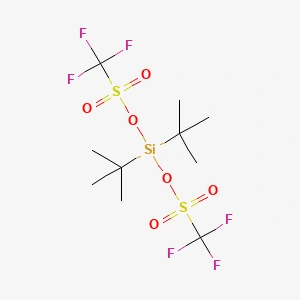
Di-tert-butylsilyl bis(trifluoromethanesulfonate)
Di-tert-butylsilyl bis(trifluoromethanesulfonate), identified by CAS number 85272-31-7, is a highly reactive organosilicon reagent frequently employed in advanced organic synthesis and pharmaceutical research. Often referred to as di-tert-butylsilyl ditriflate, this compound features a silicon center bonded to two bulky tert-butyl groups and two trifluoromethanesulfonate (triflate) leaving groups. The presence of the triflate groups makes it an exceptionally potent electrophilic silylating agent compared to corresponding halides. As a chemical raw material, it is typically handled under inert atmospheres due to its significant sensitivity to moisture and atmospheric humidity, which can lead to hydrolysis and the release of trifluoromethanesulfonic acid. Its primary industrial and research value lies in its ability to introduce the sterically demanding di-tert-butylsilyl group, which provides unique stability and selectivity profiles in complex molecular assemblies. This reagent is valued for its role in protecting functional groups and facilitating specific transformations that require precise steric control.
• Selective Protection of Diols: One of the primary applications of di-tert-butylsilyl bis(trifluoromethanesulfonate) is the protection of 1,2- and 1,3-diols. It reacts to form cyclic di-tert-butylsilylene derivatives, which are notably stable under a wide range of reaction conditions. This cyclic protection is particularly useful in carbohydrate chemistry and the synthesis of polyols where specific hydroxyl groups must be masked to allow for regioselective transformations elsewhere in the molecule.
• Sterically Hindered Silylation: Due to the bulky nature of the tert-butyl groups, this reagent is utilized to introduce silyl groups that offer superior kinetic stability against nucleophilic attack and acidic hydrolysis compared to smaller silyl protectors like trimethylsilyl (TMS) or tert-butyldimethylsilyl (TBS) groups. This makes it an essential tool for the synthesis of complex natural products where robust protection is required throughout multi-step sequences.
• Synthesis of Silacyclic Compounds: The bifunctional nature of the ditriflate allows it to serve as a precursor for various silacyclic structures. By reacting with difunctional nucleophiles, researchers can construct silicon-containing heterocycles, which are of interest in materials science and medicinal chemistry for their unique structural and electronic properties.
• Reagent in Cross-Coupling and Catalysis: Beyond simple protection, the compound acts as a versatile intermediate in the preparation of specialized silicon-based catalysts and reagents. Its high reactivity enables the efficient installation of the di-tert-butylsilyl moiety onto various organic frameworks, facilitating the development of novel synthetic methodologies and chemical probes.
Product Name: Di-tert-butylsilyl bis(trifluoromethanesulfonate)
For global customers, we provide complete technical documentation to support product evaluation, regulatory compliance and safe handling during transportation and application.