
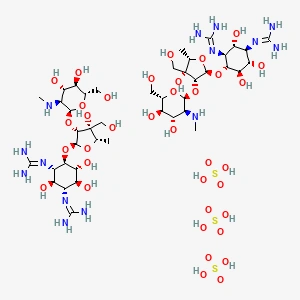
Dihydrostreptomycin sesquisulfate
Dihydrostreptomycin sesquisulfate, identified by CAS number 5490-27-7, is a semi-synthetic aminoglycoside derivative obtained through the hydrogenation of streptomycin. This chemical raw material typically appears as a white or off-white hygroscopic powder that exhibits high solubility in aqueous solutions. As a stable sulfate salt, it is valued for its consistent chemical properties and is frequently utilized in laboratory and industrial settings where high-purity aminoglycoside compounds are required.
In terms of handling and storage, dihydrostreptomycin sesquisulfate is sensitive to moisture and environmental degradation. It requires careful management within a controlled environment to maintain its integrity, typically involving airtight packaging and protection from light. Its structural stability under specific pH ranges makes it a reliable component for various chemical syntheses and specialized research applications involving protein synthesis inhibition studies.
• In microbiological research and diagnostic applications, dihydrostreptomycin sesquisulfate serves as a potent selective agent. It is incorporated into culture media to inhibit the growth of susceptible bacterial strains, particularly Gram-negative organisms, thereby facilitating the isolation and identification of resistant microbial populations. This makes it an essential tool for genetic studies and the development of selective growth protocols in laboratory environments.
• The compound is widely utilized as a standard reference material and active ingredient in the formulation of veterinary products. Within the animal health industry, it is integrated into various topical and systemic preparations designed to address specific bacterial challenges. Its role as a raw material ensures that manufacturers can produce consistent batches of treatments for livestock and companion animals, adhering to technical specifications for purity and concentration.
• Beyond its direct biological applications, dihydrostreptomycin sesquisulfate is employed in biochemical assays to study the mechanisms of protein synthesis. By binding to the 30S ribosomal subunit, it provides researchers with a mechanism to investigate translational processes and the molecular basis of aminoglycoside resistance. This research value extends to the development of new chemical derivatives and the exploration of synergistic effects when combined with other biochemical agents.
Product Name: Dihydrostreptomycin sesquisulfate
For global customers, we provide complete technical documentation to support product evaluation, regulatory compliance and safe handling during transportation and application.