
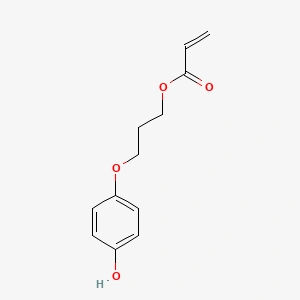
3-(4-Hydroxyphenoxy)propyl acrylate
3-(4-Hydroxyphenoxy)propyl acrylate, identified by CAS 1092853-38-7, is a specialized functional monomer characterized by its dual-reactive nature. It features an acrylate moiety capable of rapid free-radical polymerization alongside a phenolic hydroxyl group. This unique molecular architecture allows for the synthesis of polymers that retain reactive sites for post-polymerization modification or specific surface interactions. As a chemical raw material, it serves as a versatile building block in the development of advanced macromolecular structures.
The presence of the phenoxy group and the propyl spacer influences the physical properties of the resulting polymers, such as glass transition temperature and hydrophilicity. In a laboratory or industrial setting, this material is handled as a reactive intermediate, requiring standard precautions for acrylate monomers to prevent premature polymerization. Its value lies in its ability to introduce phenolic functionality into a carbon-carbon backbone, bridging the gap between traditional acrylic resins and phenolic chemistry.
• Used as a functional monomer in the synthesis of specialty polymers and copolymers. The acrylate group facilitates incorporation into various resin systems via UV-curing or thermal initiation, while the pendant hydroxyl group enables subsequent cross-linking with isocyanates or epoxies to enhance mechanical strength and chemical resistance.
• Employed in the formulation of advanced coatings and adhesives where improved adhesion to polar substrates is required. The phenolic hydroxyl group promotes hydrogen bonding with metallic or mineral surfaces, significantly enhancing the durability and interfacial bonding of the protective layer in demanding industrial environments.
• Serves as a precursor for the development of functionalized materials in electronic and optical applications. Its specific molecular structure can be utilized to tune the refractive index of optical polymers or to introduce antioxidant properties directly into the polymer matrix, thereby improving the long-term stability of components against oxidative degradation.
• Utilized in research for the creation of smart materials and responsive surfaces. The phenolic moiety provides a site for further chemical grafting or complexation, allowing for the design of polymers that can respond to environmental stimuli or act as scaffolds for biological or catalytic molecules in specialized chemical processes.
Product Name: 3-(4-Hydroxyphenoxy)propyl acrylate
For global customers, we provide complete technical documentation to support product evaluation, regulatory compliance and safe handling during transportation and application.