
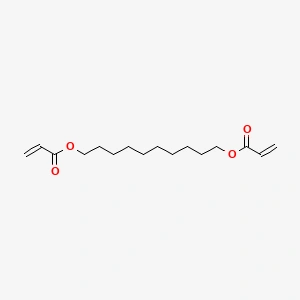
1,10-Decanediol diacrylate
1,10-Decanediol diacrylate, identified by CAS 13048-34-5, is a bifunctional monomer characterized by its long-chain aliphatic structure. As a decamethylene-based acrylate, it exhibits a unique balance of low viscosity and low volatility, making it a versatile building block in radiation-curable systems. Its molecular configuration, featuring two reactive acrylate groups separated by a ten-carbon backbone, allows for the formation of cross-linked networks with enhanced flexibility compared to shorter-chain diacrylates.
In industrial and research settings, this material is valued for its excellent solvency and efficient polymerization rates under ultraviolet (UV) or electron beam (EB) exposure. It serves as a reactive diluent that helps manage the rheological properties of formulations without compromising the final mechanical integrity. Due to its hydrophobic nature and structural stability, it contributes to the development of materials with improved moisture resistance and durability. Proper handling is essential, as with most acrylate monomers, to ensure stability and prevent premature polymerization during storage.
• In the formulation of UV-curable coatings and varnishes, 1,10-Decanediol diacrylate acts as a high-performance reactive diluent. Its long aliphatic chain imparts significant flexibility to the cured film, reducing brittleness and improving adhesion to various substrates, including plastics and metals. It is particularly effective in applications requiring a balance between hardness and impact resistance.
• Within the printing ink industry, this monomer is utilized to adjust viscosity and improve the flow characteristics of offset, flexographic, and screen-printing inks. Its low volatility ensures a stable process environment, while its rapid curing response supports high-speed production lines. The resulting ink layers demonstrate enhanced weatherability and resistance to chemical degradation.
• The compound is extensively used in the production of structural adhesives and sealants. By incorporating this bifunctional monomer, manufacturers can tailor the cross-link density of the polymer matrix, leading to improved elongation and stress-relaxation properties. This makes it ideal for bonding components that undergo thermal expansion or mechanical vibration.
• In specialized electronics and advanced materials research, it serves as a precursor for photoresists and stereolithography resins. Its ability to form tough, moisture-resistant polymers makes it suitable for encapsulating sensitive electronic components or creating 3D-printed parts that require specific mechanical toughness and dimensional stability.
Product Name: 1,10-Decanediol diacrylate
For global customers, we provide complete technical documentation to support product evaluation, regulatory compliance and safe handling during transportation and application.