
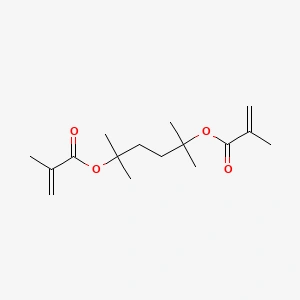
2,5-Dimethylhexane-2,5-diyl bis(2-methylacrylate)
2,5-Dimethylhexane-2,5-diyl bis(2-methylacrylate), identified by CAS 131787-39-8, is a specialized bifunctional monomer characterized by its unique branched aliphatic structure. This compound features two methacrylate functional groups attached to a 2,5-dimethylhexane backbone, providing a distinct combination of reactivity and structural rigidity. As a crosslinking agent, it is valued for its ability to enhance the mechanical and thermal properties of various polymer systems while maintaining a degree of hydrophobicity.
In industrial and research settings, this material is recognized for its low volatility and excellent compatibility with other acrylic and methacrylic resins. Its handling requires standard laboratory precautions typical of acrylate esters, focusing on maintaining stability through proper storage conditions. The presence of the branched alkane chain offers specific advantages in controlling the crosslink density and flexibility of the resulting polymer networks compared to linear counterparts.
• As a high-performance crosslinking agent, this monomer is utilized in the synthesis of specialized thermosetting resins and elastomers. The bifunctional nature allows for the creation of robust three-dimensional networks, which significantly improve the solvent resistance, tensile strength, and thermal stability of the final polymer product in demanding industrial environments.
• In the field of advanced coatings and adhesives, CAS 131787-39-8 serves as a reactive diluent or structural component. Its inclusion helps in fine-tuning the viscosity of formulations before curing, while the branched hexane bridge contributes to improved moisture resistance and adhesion to various substrates, making it suitable for protective layers in electronics or automotive applications.
• The compound is frequently employed in the development of dental materials and medical-grade polymers where precise control over polymerization shrinkage and mechanical durability is essential. The steric hindrance provided by the dimethylhexane core can influence the kinetics of the free-radical polymerization process, resulting in materials with tailored refractive indices and optimized wear resistance.
• It finds application in the production of optical materials and photoresists within the semiconductor industry. Its ability to undergo rapid UV-initiated polymerization makes it an ideal candidate for lithographic processes, where it contributes to high-resolution patterning and structural integrity of micro-fabricated components through its stable crosslinked architecture.
Product Name: 2,5-Dimethylhexane-2,5-diyl bis(2-methylacrylate)
For global customers, we provide complete technical documentation to support product evaluation, regulatory compliance and safe handling during transportation and application.