
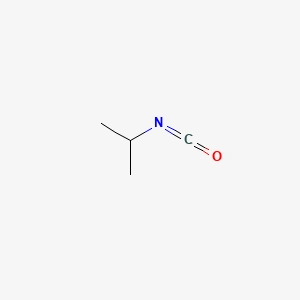
Isopropyl isocyanate
Isopropyl isocyanate, identified by CAS number 1795-48-8, is a highly reactive organic compound belonging to the isocyanate functional group. It typically presents as a colorless to slightly yellowish liquid characterized by a sharp, pungent odor. As a low molecular weight aliphatic isocyanate, it exhibits significant volatility and flammability, requiring stringent handling protocols and specialized storage conditions to ensure stability and safety. Its chemical structure, featuring the N=C=O group attached to an isopropyl moiety, makes it an essential building block in various synthetic pathways.
In industrial and research settings, this compound is valued for its ability to undergo addition reactions with nucleophiles such as alcohols and amines. Because it is moisture-sensitive, it reacts readily with water to form isopropylamine and carbon dioxide, necessitating anhydrous conditions during processing. It serves as a versatile intermediate for the production of fine chemicals, where precise control over molecular architecture is required. Its reactivity profile demands rigorous containment and protective measures to mitigate risks associated with its toxicity and vapor pressure.
• Isopropyl isocyanate serves as a critical intermediate in the synthesis of specialized carbamate and urea derivatives. By reacting with various alcohols or amines, it facilitates the production of N-isopropyl carbamates and N,N’-substituted ureas, which are foundational components in the development of crop protection agents and pharmaceutical precursors.
• The compound is widely utilized in the fine chemical industry for the modification of polymers and surfaces. Its reactive isocyanate group allows for the introduction of isopropyl functionality onto polymer backbones or substrate surfaces, enhancing properties such as solubility, adhesion, or chemical resistance in specialized coating applications.
• In medicinal chemistry and drug discovery, it acts as a reagent for the preparation of bioactive molecules. It is frequently employed to synthesize specific molecular scaffolds that require the isopropyl group to achieve desired steric or electronic effects, contributing to the development of enzyme inhibitors and other therapeutic candidates.
• It is also used as a laboratory reagent in organic synthesis for the preparation of isocyanate-derived standards. Its predictable reactivity makes it a reliable tool for chemists performing complex multi-step syntheses where the introduction of a branched alkyl isocyanate moiety is necessary for structural diversity.
Product Name: Isopropyl isocyanate
For global customers, we provide complete technical documentation to support product evaluation, regulatory compliance and safe handling during transportation and application.