
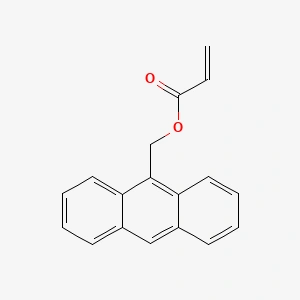
9-Anthracenylmethyl acrylate
9-Anthracenylmethyl acrylate, identified by CAS number 31645-34-8, is a specialized monomer that integrates a polycyclic aromatic hydrocarbon—anthracene—with a reactive acrylate functional group. This yellow to light-orange crystalline solid is highly valued in material science due to its unique combination of optical properties and polymerizable nature. The presence of the anthracene moiety imparts strong fluorescence and sensitivity to ultraviolet light, making it a versatile building block for synthesizing functional polymers.
In terms of chemical behavior, this compound undergoes standard radical or ionic polymerization, allowing for the incorporation of the anthracene chromophore into various polymer architectures. It is typically handled with care to avoid premature polymerization, often requiring storage in cool, dark environments away from light and heat. Its high purity and predictable reactivity make it an essential reagent for researchers developing advanced optoelectronic materials and sensors.
• This monomer is extensively utilized in the synthesis of fluorescent polymers and copolymers. By incorporating the 9-anthracenylmethyl group into a polymer backbone, researchers can create materials with tunable photoluminescence, which are critical for developing chemical sensors, bio-imaging probes, and specialized markers in complex fluid dynamics studies.
• In the field of photochemistry, 9-Anthracenylmethyl acrylate serves as a key component for creating photo-responsive materials. The anthracene group is capable of reversible [4+4] photocycloaddition under specific UV wavelengths, enabling the design of self-healing polymers, photo-crosslinkable coatings, and materials with reversible mechanical or optical properties.
• The compound is also employed in the production of plastic scintillators and optical devices. Its high fluorescence quantum yield and efficient energy transfer capabilities make it suitable for radiation detection applications, where it acts as a secondary fluor to shift emission wavelengths into a range detectable by standard photomultiplier tubes.
• Furthermore, it finds application in the fabrication of organic electronic components, such as organic light-emitting diodes (OLEDs) and organic field-effect transistors (OFETs). The rigid, planar structure of the anthracene unit facilitates efficient charge transport and pi-stacking, contributing to the development of high-performance semiconducting polymers and thin-film devices.
Product Name: 9-Anthracenylmethyl acrylate
For global customers, we provide complete technical documentation to support product evaluation, regulatory compliance and safe handling during transportation and application.