
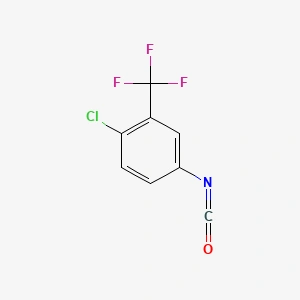
4-chloro-3-(trifluoromethyl)phenyl isocyanate
4-chloro-3-(trifluoromethyl)phenyl isocyanate, identified by CAS number 327-78-6, is a highly reactive organic building block characterized by the presence of a trifluoromethyl group and a chlorine atom on a phenyl ring. This specific substitution pattern imparts unique electronic and lipophilic properties to the molecules derived from it. As an isocyanate, it serves as a versatile electrophilic reagent, readily reacting with various nucleophiles such as amines and alcohols to form stable urea and carbamate linkages.
In industrial and laboratory settings, this compound is valued for its role in synthesizing complex organic structures. Due to the moisture-sensitive nature of the isocyanate functional group, it requires careful handling under anhydrous conditions, typically using inert gas atmospheres. Its chemical stability and reactivity profile make it a critical intermediate for producing high-value derivatives where the trifluoromethyl moiety is essential for enhancing biological activity or material performance.
• Pharmaceutical Synthesis: This compound serves as a vital intermediate in the production of various active pharmaceutical ingredients. It is notably utilized in the synthesis of kinase inhibitors and other medicinal agents where the 4-chloro-3-(trifluoromethyl)phenyl moiety is a key pharmacophore. The trifluoromethyl group often improves the metabolic stability and binding affinity of the resulting drug molecules.
• Agrochemical Development: In the field of crop protection, 4-chloro-3-(trifluoromethyl)phenyl isocyanate is employed to manufacture advanced herbicides and fungicides. Its ability to form stable urea-based linkages allows for the creation of potent compounds that exhibit high efficacy against specific agricultural pests while maintaining the desired environmental degradation profiles.
• Specialty Polymer Chemistry: The reagent is used in the modification of polymers and the synthesis of specialized polyurethanes. By incorporating the trifluoromethylated aromatic ring into the polymer backbone or as a side chain, manufacturers can enhance the thermal stability, chemical resistance, and hydrophobic properties of the final material, making it suitable for high-performance industrial applications.
• Chemical Research and Derivatization: Beyond large-scale manufacturing, this isocyanate is a frequent choice for laboratory-scale synthesis of novel organic compounds. It acts as a reliable derivatizing agent for characterization studies and is used to explore the structure-activity relationships of new chemical entities in materials science and medicinal chemistry research.
Product Name: 4-chloro-3-(trifluoromethyl)phenyl isocyanate
For global customers, we provide complete technical documentation to support product evaluation, regulatory compliance and safe handling during transportation and application.