
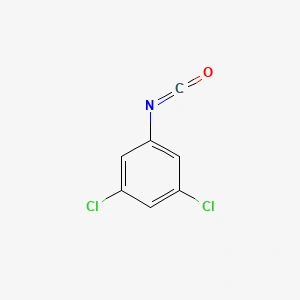
3,5-dichlorophenyl isocyanate
3,5-Dichlorophenyl isocyanate, identified by CAS number 34893-92-0, is a specialized organic building block characterized by its highly reactive isocyanate functional group attached to a 3,5-disubstituted benzene ring. This compound typically appears as a white to light yellow crystalline solid or a low-melting liquid, depending on the ambient temperature. Its structural symmetry and the presence of two chlorine atoms at the meta-positions provide unique electronic properties that are highly valued in synthetic organic chemistry.
In a laboratory or industrial setting, this reagent is recognized for its sensitivity to moisture and its ability to undergo rapid addition reactions with nucleophiles. Due to its reactive nature, it must be handled under anhydrous conditions, typically using inert gas shielding to prevent degradation into the corresponding urea. It serves as a critical intermediate for the synthesis of complex molecules, offering a reliable pathway for introducing the 3,5-dichlorophenyl moiety into various chemical architectures.
• Agrochemical Synthesis: This compound is widely utilized as a key intermediate in the production of various pesticides, herbicides, and fungicides. The 3,5-dichlorophenyl group is a common pharmacophore in agricultural chemistry, where it contributes to the biological activity and metabolic stability of the final active ingredients, particularly in the development of carbamate-based crop protection agents.
• Pharmaceutical Research: In the pharmaceutical industry, 3,5-dichlorophenyl isocyanate serves as a versatile reagent for the synthesis of urea and carbamate derivatives. These functional groups are frequently found in drug candidates targeting enzyme inhibition or receptor modulation. Its specific substitution pattern allows medicinal chemists to explore structure-activity relationships in the design of novel therapeutic compounds.
• Polymer and Materials Science: The reagent is employed in the modification of polymers and the synthesis of specialty materials. By reacting with hydroxyl or amine-functionalized resins, it can introduce chlorinated aromatic groups that enhance the thermal stability, flame retardancy, or chemical resistance of the resulting materials, making it useful for high-performance coatings and adhesives.
• Chemical Derivatization: It acts as a standard derivatizing agent in analytical chemistry and organic synthesis for the characterization of alcohols and amines. The resulting carbamates or ureas are often stable, crystalline solids that facilitate the identification and purification of primary and secondary nucleophilic substrates through standard laboratory techniques.
Product Name: 3,5-dichlorophenyl isocyanate
For global customers, we provide complete technical documentation to support product evaluation, regulatory compliance and safe handling during transportation and application.