
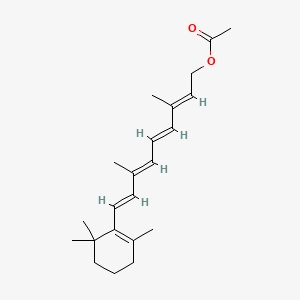
Retinyl acetate
Retinyl acetate, identified by CAS number 127-47-9, is a natural form of Vitamin A and the acetate ester of retinol. It typically appears as a pale yellow crystalline solid or a viscous liquid, depending on the temperature and purity. As a fat-soluble retinoid, it exhibits significant stability compared to pure retinol, making it a preferred precursor in various industrial formulations. It is chemically characterized by its unsaturated hydrocarbon chain and ester linkage, which requires careful storage away from light and oxygen to prevent degradation.
In industrial and research settings, retinyl acetate serves as a critical synthetic intermediate and a stable source of Vitamin A activity. Its handling requires specific protocols, often involving inert atmospheres and amber glass containers to maintain potency. Because it is easily converted to other retinoids within biological systems, it is highly valued for its predictable behavior in laboratory assays and formulation science, bridging the gap between raw chemical synthesis and functional applications.
• In the personal care and cosmetic industry, retinyl acetate is utilized as a conditioning agent and a stable retinoid derivative. It is incorporated into topical formulations like creams and serums to support skin health research, where it acts as a precursor that the skin can enzymatically convert into active forms of Vitamin A.
• Within the food and beverage sector, this compound is extensively used for the fortification of fats, oils, and dairy products. Its enhanced stability over free retinol allows for more consistent nutritional profiles in processed goods, ensuring that the Vitamin A content remains viable throughout the product’s shelf life.
• In the pharmaceutical and nutraceutical fields, it serves as a primary ingredient in dietary supplements and multivitamin preparations. It is favored for its high bioavailability and ease of encapsulation, providing a reliable method for addressing nutritional deficiencies in both human and animal health applications.
• For laboratory and analytical research, retinyl acetate acts as a standard reference material for testing retinoid concentrations and studying metabolic pathways. Researchers employ it to investigate the biochemical effects of Vitamin A derivatives on cellular growth, differentiation, and vision-related biological processes.
Product Name: Retinyl acetate
For global customers, we provide complete technical documentation to support product evaluation, regulatory compliance and safe handling during transportation and application.