
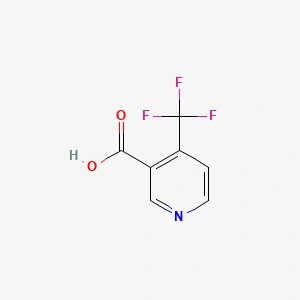
4-(Trifluoromethyl)pyridine-3-carboxylic acid
4-(Trifluoromethyl)pyridine-3-carboxylic acid, identified by CAS number 158063-66-2, is a versatile fluorinated heterocyclic building block widely utilized in advanced organic synthesis. This compound features a pyridine scaffold substituted with a carboxylic acid group at the 3-position and a trifluoromethyl group at the 4-position. The presence of the trifluoromethyl moiety significantly influences the electronic properties and lipophilicity of the molecule, making it a critical intermediate for developing specialized chemical entities.
In a research and industrial context, this compound serves as a key precursor for the synthesis of complex molecules, particularly in the fields of agrochemicals and performance materials. Its structural rigidity and the specific orientation of its functional groups allow for precise molecular engineering. Proper handling requires standard laboratory safety protocols, as the material is typically managed in controlled environments to maintain its chemical integrity and ensure operator safety during synthesis procedures.
• As a specialized building block in medicinal chemistry research, this compound is frequently employed to introduce the 4-trifluoromethylnicotinic acid moiety into potential drug candidates. The trifluoromethyl group is highly valued for its ability to enhance the metabolic stability and bioavailability of small molecules, while the pyridine ring provides essential nitrogen-based interactions within biological targets.
• In the development of advanced agrochemicals, 4-(Trifluoromethyl)pyridine-3-carboxylic acid serves as a critical intermediate for synthesizing herbicides and fungicides. The unique substitution pattern helps in fine-tuning the biological activity and environmental persistence of the final products, allowing for the creation of more effective and targeted crop protection agents.
• The compound is also utilized in the field of materials science, specifically in the synthesis of functional polymers and coordination complexes. Its carboxylic acid group facilitates conjugation with various substrates, while the electron-withdrawing trifluoromethyl group modifies the optical and electronic properties of the resulting materials, making it useful for specialized chemical sensors or electronic applications.
• Furthermore, it acts as a versatile reagent in general organic synthesis for the preparation of substituted pyridines via decarboxylation, esterification, or amide formation. Its reactivity profile allows chemists to access a broad range of derivatives that are otherwise difficult to synthesize, thereby expanding the toolbox for heterocyclic chemistry and molecular design.
Product Name: 4-(Trifluoromethyl)pyridine-3-carboxylic acid
For global customers, we provide complete technical documentation to support product evaluation, regulatory compliance and safe handling during transportation and application.