
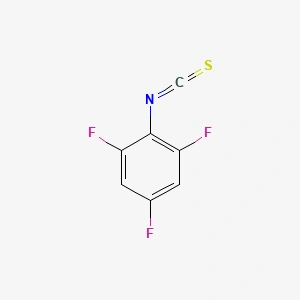
1,3,5-Trifluoro-2-isothiocyanatobenzene
1,3,5-Trifluoro-2-isothiocyanatobenzene, identified by CAS number 206761-91-3, is a specialized organofluorine building block characterized by the presence of an isothiocyanate functional group attached to a trifluorinated benzene ring. This compound serves as a highly reactive intermediate in organic synthesis, where the electron-withdrawing nature of the three fluorine atoms significantly influences the reactivity of the isothiocyanate moiety. Its unique substitution pattern makes it a valuable tool for researchers looking to introduce specific fluorinated motifs into complex molecular frameworks.
In a laboratory or industrial setting, this compound is primarily utilized for the construction of heterocyclic systems and the modification of biomolecules. Due to the inherent reactivity of the isothiocyanate group, it is sensitive to moisture and should be handled under inert atmospheric conditions to prevent degradation. Proper safety protocols are essential, as isothiocyanates are typically irritants and may exhibit lachrymatory properties. Its strategic use allows for the fine-tuning of lipophilicity and metabolic stability in various chemical derivatives.
• As a versatile electrophilic reagent, 1,3,5-Trifluoro-2-isothiocyanatobenzene is extensively used in the synthesis of fluorinated thioureas and thioamides. These derivatives are critical intermediates in the development of pharmaceutical candidates, where the trifluorophenyl group can enhance binding affinity and modulate the physicochemical properties of the final drug molecule.
• The compound serves as a key precursor for the formation of diverse heterocyclic compounds, including benzothiazoles, quinazolines, and various sulfur-containing rings. By reacting with bifunctional nucleophiles, it enables the rapid assembly of complex scaffolds used in the discovery of new agrochemicals and specialty materials.
• In the field of chemical biology, this isothiocyanate derivative is employed as a labeling agent or molecular probe. The strong reactivity of the functional group towards primary amines allows for the covalent modification of proteins and peptides, facilitating studies on molecular recognition and enzyme inhibition within biological systems.
• It is frequently applied in materials science for the surface modification of polymers and nanoparticles. The introduction of the trifluorophenyl thio-linkage can alter surface energy, improve chemical resistance, or provide specific anchoring points for further functionalization in the fabrication of advanced coatings and sensors.
Product Name: 1,3,5-Trifluoro-2-isothiocyanatobenzene
For global customers, we provide complete technical documentation to support product evaluation, regulatory compliance and safe handling during transportation and application.