
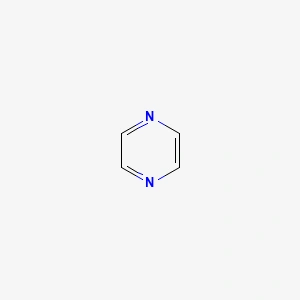
pyrazine phase IV
Pyrazine (CAS 290-37-9) is a fundamental heterocyclic aromatic organic compound characterized by a six-membered ring containing two nitrogen atoms at the 1 and 4 positions. As a symmetrical diazine, it serves as a critical structural motif in various natural and synthetic substances. In its pure state, pyrazine typically appears as a colorless to pale yellow crystalline solid or liquid, depending on ambient temperature, and is known for its distinct, often potent aroma. Its chemical stability and unique electronic properties make it a versatile precursor in complex organic synthesis.
In industrial and research settings, pyrazine is valued for its role as a foundational building block. It exhibits weak basicity and can form stable complexes with various metal ions, making it a subject of interest in coordination chemistry and materials science. Due to its volatility and reactive nature, handling requires appropriate safety protocols, including storage in cool, dry environments away from strong oxidizing agents. Its utility spans across multiple high-value sectors, from fine chemicals to advanced molecular design.
• In the pharmaceutical industry, pyrazine and its derivatives serve as essential intermediates for the synthesis of various bioactive compounds. Its heterocyclic framework is found in several therapeutic agents, including antitubercular drugs and certain diuretic medications. Researchers utilize the pyrazine core to modify molecular structures, enhancing the pharmacological profiles and binding affinities of potential drug candidates during the drug discovery process.
• The flavor and fragrance sector extensively employs pyrazine-based chemistry to create specific sensory profiles. Alkylpyrazines, derived from the parent pyrazine structure, are responsible for the characteristic nutty, roasted, or toasted aromas found in coffee, cocoa, and baked goods. By utilizing pyrazine as a starting material, chemists can synthesize a wide array of flavoring agents that replicate complex natural scents, making it indispensable for the production of aromatic compositions.
• Within the field of coordination chemistry and materials science, pyrazine acts as an effective bridging ligand. Its ability to coordinate with transition metal centers allows for the assembly of metal-organic frameworks (MOFs) and coordination polymers with specific magnetic or electronic properties. These materials are investigated for applications in gas storage, catalysis, and molecular sensing, leveraging the rigid and symmetrical nature of the pyrazine ring to create predictable crystalline architectures.
• Pyrazine is also utilized as a specialty reagent in organic synthesis for the preparation of more complex heterocyclic systems. It undergoes various substitution and reduction reactions, enabling the development of advanced dyes, agricultural chemicals, and functional polymers. Its role as a versatile synthetic tool allows for the efficient construction of nitrogen-rich molecules, supporting innovation in chemical manufacturing and academic research projects.
Product Name: pyrazine phase IV
For global customers, we provide complete technical documentation to support product evaluation, regulatory compliance and safe handling during transportation and application.