
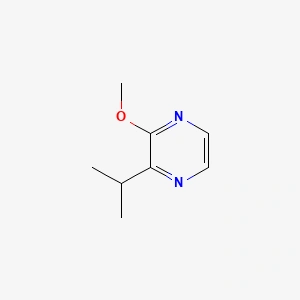
Pyrazine, 2-methoxy-3-(1-methylethyl)-
Pyrazine, 2-methoxy-3-(1-methylethyl)-, commonly referred to as 2-isopropyl-3-methoxypyrazine, is a highly potent heterocyclic organic compound characterized by its distinct and powerful aromatic profile. As a member of the methoxypyrazine family, this chemical exhibits a remarkably low odor threshold, making it detectable even at extremely low concentrations. It appears as a colorless to pale yellow liquid and is valued for its ability to impart specific earthy and vegetal notes to various formulations.
In industrial and research settings, this compound is handled with care due to its intense sensory impact. It is primarily utilized as a high-impact aroma chemical within the flavor and fragrance sectors. Its chemical stability and solubility in organic solvents allow for precise integration into complex mixtures, where it serves as a critical building block for recreating natural scents and flavors. The compound’s unique molecular structure, featuring an isopropyl group and a methoxy group on the pyrazine ring, defines its characteristic sensory properties.
• In the flavor industry, this compound is indispensable for creating authentic savory and vegetable-based flavor profiles. It is frequently employed to replicate the fresh, green notes of green peas, bell peppers, and asparagus. Because of its high potency, it is typically used in highly diluted forms to enhance the complexity of food products, providing a naturalistic earthy or garden-fresh quality that is difficult to achieve with other chemical constituents.
• Within the fragrance sector, 2-isopropyl-3-methoxypyrazine serves as a specialized top or heart note in perfumery. It is utilized to add a realistic green or mossy nuance to floral and woody compositions. Perfumers leverage its unique ability to cut through heavier base notes, introducing a crisp, atmospheric quality that mimics the scent of damp earth or crushed foliage, which is essential for modern, nature-inspired fragrance designs.
• The compound plays a significant role in the beverage industry, particularly in the analysis and standardization of wine profiles. It is a naturally occurring component in certain grape varieties, such as Sauvignon Blanc and Cabernet Sauvignon, contributing to their characteristic herbaceous character. Consequently, it is used as a reference standard in analytical chemistry and sensory evaluation to ensure consistency and quality in viticulture and enology research.
• Beyond its primary sensory applications, this pyrazine derivative is utilized as an intermediate in chemical synthesis and laboratory research. Its specific substitution pattern makes it a useful reagent for studying the structure-activity relationships of heterocyclic odorants. Researchers utilize the compound to explore the mechanisms of olfactory perception and to develop new synthetic pathways for related pyrazine derivatives used in specialized industrial applications.
Product Name: Pyrazine, 2-methoxy-3-(1-methylethyl)-
For global customers, we provide complete technical documentation to support product evaluation, regulatory compliance and safe handling during transportation and application.