
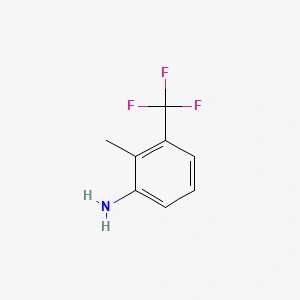
2-Methyl-3-(trifluoromethyl)aniline
2-Methyl-3-(trifluoromethyl)aniline, identified by CAS number 54396-44-0, is a specialized aromatic amine characterized by the presence of both a methyl group and a trifluoromethyl substituent on the benzene ring. This specific substitution pattern imparts unique electronic and steric properties to the molecule, making it a highly sought-after building block in organic synthesis. As a derivative of aniline, it serves as a versatile intermediate for the construction of more complex fluorinated compounds.
In industrial and research settings, this compound is valued for its ability to introduce the trifluoromethyl moiety, which often enhances the metabolic stability and lipophilicity of the resulting molecules. Handling requires standard laboratory precautions for aromatic amines, including the use of appropriate personal protective equipment and ventilation. Its chemical stability under controlled conditions allows for its use in a variety of synthetic pathways, ranging from catalytic couplings to condensation reactions.
• Pharmaceutical Synthesis: This compound serves as a critical intermediate in the production of non-steroidal anti-inflammatory drugs (NSAIDs) and other therapeutic agents. The trifluoromethyl group is particularly important in medicinal chemistry for improving the bioavailability and binding affinity of drug candidates, and this specific isomer allows for precise structural orientation during the synthesis of molecules like flunixin.
• Agrochemical Development: In the field of crop protection, 2-Methyl-3-(trifluoromethyl)aniline is utilized to synthesize high-performance herbicides and fungicides. The incorporation of fluorine atoms into agrochemical structures often leads to increased potency and targeted activity against specific pests or pathogens, while the methyl group provides a site for further functionalization or metabolic tuning.
• Specialty Chemical Manufacturing: Beyond life sciences, this chemical is employed as a precursor for specialized dyes, pigments, and advanced materials. Its unique substitution pattern influences the optical and physical properties of the final products, making it useful in the development of high-performance polymers or electronic chemicals that require specific thermal and chemical resistance.
• Chemical Research and Methodology: It is frequently used in academic and industrial research as a reagent for exploring new synthetic methodologies, particularly in the development of C-H activation or cross-coupling reactions. Researchers utilize its distinct electronic profile to study the effects of trifluoromethyl groups on the reactivity of aromatic systems, contributing to the broader understanding of organofluorine chemistry.
Product Name: 2-Methyl-3-(trifluoromethyl)aniline
For global customers, we provide complete technical documentation to support product evaluation, regulatory compliance and safe handling during transportation and application.