
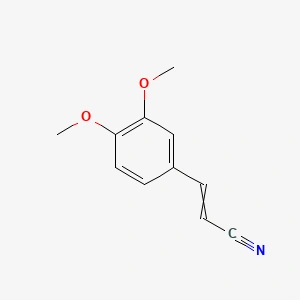
3-(3,4-Dimethoxyphenyl)-2-propenenitrile
3-(3,4-Dimethoxyphenyl)-2-propenenitrile, identified by CAS number 6443-72-7, is a specialized organic compound characterized by its substituted cinnamonitrile structure. It features a propenenitrile backbone linked to a benzene ring with two methoxy groups at the 3 and 4 positions. This chemical is typically encountered as a crystalline solid and serves as a versatile building block in the synthesis of complex organic molecules. Its unique electronic properties, derived from the conjugation between the nitrile group and the electron-rich aromatic ring, make it a valuable reagent in various chemical transformations.
In terms of handling, this compound is primarily utilized within laboratory and industrial settings where controlled environments are maintained. It is valued for its stability under standard conditions and its reactivity in nucleophilic additions and cycloaddition reactions. As an essential intermediate, it plays a critical role in the development of fine chemicals and specialty materials, providing a reliable pathway for introducing the dimethoxyphenyl moiety into larger molecular architectures.
• As a versatile synthetic intermediate, 3-(3,4-Dimethoxyphenyl)-2-propenenitrile is widely employed in the production of pharmaceutical precursors. It serves as a foundational scaffold for the synthesis of various biologically active compounds, particularly those requiring a dimethoxyphenyl ethylamine or related structural motif. Its reactive nitrile group allows for conversion into carboxylic acids, amides, or amines, facilitating the assembly of complex drug candidates.
• In the field of material science, this compound is utilized in the development of functional polymers and organic electronics. The conjugated system within the molecule contributes to specific optical and electronic characteristics, making it useful for researchers investigating charge transport properties or fluorescent markers. It can be integrated into larger polymeric chains to modify the physical and chemical behavior of the resulting materials.
• The compound is frequently used in organic chemistry research for the study of Michael addition reactions and other carbon-carbon bond-forming processes. Its structure allows for regioselective and stereoselective reactions, making it an excellent model substrate for testing new catalytic systems or synthetic methodologies. This utility makes it a staple reagent in academic and industrial R&D laboratories focused on advanced organic synthesis.
• Furthermore, it acts as a key precursor in the synthesis of agrochemicals and specialty dyes. The dimethoxy substitution pattern is a common feature in many naturally occurring and synthetic bioactive molecules, and this nitrile provides a convenient entry point for creating derivatives with tailored solubility and reactivity profiles for specific industrial applications.
Product Name: 3-(3,4-Dimethoxyphenyl)-2-propenenitrile
For global customers, we provide complete technical documentation to support product evaluation, regulatory compliance and safe handling during transportation and application.