
Grubbs Catalyst M101 (CAS: 250220-36-1) is a first-generation ruthenium indenylidene metathesis catalyst in which two bulky tricyclohexylphosphine ligands stabilise the active ruthenium centre. It promotes ring-closing, ring-opening and cross metathesis under mild conditions and tolerates many functional groups, so it is widely chosen for well-defined, easily reproducible transformations. The indenylidene fragment provides good thermal stability, while the phosphine ligands make the catalyst comparatively easy to handle for a ruthenium system. Supplied as a high-purity solid that is soluble in dichloromethane, toluene and similar aprotic solvents.
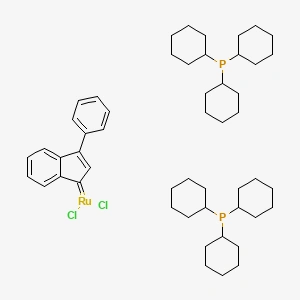
Grubbs Catalyst M101
Category:Electronic Chemicals
CAS No.:250220-36-1
Product Grade: Industrial Grade
Purity / Assay: 98%
Molecular Formula:C₅₁H₇₆Cl₂P₂Ru
Molecular Weight:923.10
Synonym(s):Grubbs Catalyst M101; Umicore M101; Dichloro(3-phenyl-1H-inden-1-ylidene)bis(tricyclohexylphosphine)ruthenium
Grubbs Catalyst M101 (CAS: 250220-36-1) is a first-generation ruthenium indenylidene metathesis catalyst in which two bulky tricyclohexylphosphine ligands stabilise the active ruthenium centre. It promotes ring-closing, ring-opening and cross metathesis under mild conditions and tolerates many functional groups, so it is widely chosen for well-defined, easily reproducible transformations. The indenylidene fragment provides good thermal stability, while the phosphine ligands make the catalyst comparatively easy to handle for a ruthenium system. Supplied as a high-purity solid that is soluble in dichloromethane, toluene and similar aprotic solvents.
• Ring-closing metathesis: used to form five- to seven-membered rings in pharmaceutical and fine chemical synthesis.
• Ring-opening metathesis polymerisation: applied in the production of specialty polymers from cyclic olefins.
• Cross metathesis: enables selective formation of carbon–carbon double bonds between functionalised olefins.
• Process development: suited to pilot and commercial scale-up where a robust, well-characterised catalyst is required.
1kg/bottle, 25kg/drum
CAS No.: 250220-36-1
Product Name: Grubbs Catalyst M101
Purity / Assay:98%
Molecular Formula:C₅₁H₇₆Cl₂P₂Ru
Molecular Weight:923.10
Synonym(s):Grubbs Catalyst M101; Umicore M101; Dichloro(3-phenyl-1H-inden-1-ylidene)bis(tricyclohexylphosphine)ruthenium
For global customers, we provide complete technical documentation to support product evaluation, regulatory compliance and safe handling during transportation and application.