
Lauroyl Chloride (CAS: 112-16-3), also called dodecanoyl chloride, is a long-chain fatty acyl chloride derived from lauric acid. Supplied as a colorless to pale-yellow liquid, it serves as an acylating reagent and intermediate for organic synthesis. Its reactive acyl chloride group supports preparation of esters and amides. Additional applications include specialty materials modification and surfactant-related synthesis, extending its role beyond general synthetic building-block use. Because the material reacts with moisture, it should be kept tightly sealed and dry and handled with suitable protective equipment.
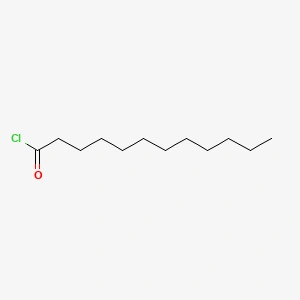
Lauroyl Chloride
Category:Organic Intermediates
CAS No.:112-16-3
Product Grade: Industrial Grade
Purity / Assay: 98%
Molecular Formula:C₁₂H₂₃ClO
Molecular Weight:218.76 g/mol
EINECS No.:203-941-7
Synonym(s):Dodecanoyl chloride; Lauric acid chloride; n-Dodecanoyl chloride
Lauroyl Chloride (CAS: 112-16-3), also called dodecanoyl chloride, is a long-chain fatty acyl chloride derived from lauric acid. Supplied as a colorless to pale-yellow liquid, it serves as an acylating reagent and intermediate for organic synthesis. Its reactive acyl chloride group supports preparation of esters and amides. Additional applications include specialty materials modification and surfactant-related synthesis, extending its role beyond general synthetic building-block use. Because the material reacts with moisture, it should be kept tightly sealed and dry and handled with suitable protective equipment.
• Used as an acylating reagent and intermediate in the synthesis of surfactants and other specialty organic chemicals.
• Reacts with alcohols to introduce lauroyl groups and form esters, and with amines for amide synthesis.
• Applied to modify nanocellulose, nanofibrillated cellulose and cellulose nanocrystals, tailoring material surface properties.
• Used in collagen acylation to improve water solubility and surface activity, and in specialty polymer and bio-based material modification.
25kg/drum, 200L/drum
CAS No.: 112-16-3
Product Name: Lauroyl Chloride
Purity / Assay:98%
Molecular Formula:C₁₂H₂₃ClO
Molecular Weight:218.76 g/mol
EINECS No.:203-941-7
Synonym(s):Dodecanoyl chloride; Lauric acid chloride; n-Dodecanoyl chloride
For global customers, we provide complete technical documentation to support product evaluation, regulatory compliance and safe handling during transportation and application.