
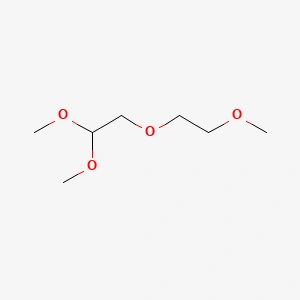
1,1-Dimethoxy-2-(2-methoxyethoxy)ethane
1,1-Dimethoxy-2-(2-methoxyethoxy)ethane, identified by CAS 94158-44-8, is a specialized organic building block primarily utilized as a protected aldehyde intermediate in fine chemical synthesis. Structurally, the compound features a dimethyl acetal group and a methoxyethoxy ether chain, a combination that provides unique chemical stability and solubility characteristics. As an acetal, it remains stable under neutral and basic conditions, allowing chemists to perform complex synthetic sequences without affecting the latent aldehyde functionality. This material is typically handled as a liquid and is valued for its ability to introduce functionalized oxygenated chains into molecular frameworks. Its industrial and research significance lies in its role as a versatile precursor for high-value derivatives where precise control over reactivity is required. Proper storage and handling are essential, particularly the exclusion of moisture and acidic catalysts, to prevent premature hydrolysis and ensure consistent performance in sensitive chemical processes.
• Organic Synthesis and Protecting Group Chemistry: The compound serves as a robust precursor for methoxyethoxyacetaldehyde. The dimethyl acetal moiety acts as an efficient protecting group, enabling selective chemical transformations on other functional groups within a molecule. The aldehyde can be subsequently deprotected under mild acidic conditions for further condensation or oxidation reactions.
• Pharmaceutical and Agrochemical Development: It is frequently employed as a key intermediate in the synthesis of bioactive molecules. The methoxyethoxy substituent is often integrated into drug candidates or crop protection agents to modulate lipophilicity, improve metabolic stability, or enhance the pharmacokinetic profile of the final active ingredient.
• Specialty Polymer and Resin Modification: This material is utilized in the production of functionalized polymers and specialty resins. By incorporating the methoxyethoxy-ethylidene unit, manufacturers can tailor the hydrophilicity, glass transition temperature, and adhesive properties of polymer matrices used in advanced coatings and electronic materials.
• Electrolyte and Solvent Research: Due to its high oxygen content and ability to coordinate with metal cations, the compound is investigated for use in specialty electrolyte formulations and as a high-boiling solvent additive in electrochemical applications, where it contributes to improved ionic conductivity and thermal stability.
Product Name: 1,1-Dimethoxy-2-(2-methoxyethoxy)ethane
For global customers, we provide complete technical documentation to support product evaluation, regulatory compliance and safe handling during transportation and application.