
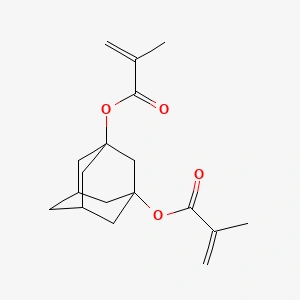
1,3-Adamantanediol dimethacrylate
1,3-Adamantanediol dimethacrylate, identified by CAS 122066-43-7, is a specialized bifunctional monomer characterized by a rigid tricyclic adamantane core substituted with two methacrylate functional groups. This unique molecular architecture imparts exceptional thermal stability, high glass transition temperatures, and significant mechanical strength to the resulting polymers. As a high-purity chemical raw material, it is valued for its ability to enhance the physical properties of cross-linked systems while maintaining excellent transparency and low volume shrinkage during polymerization.
In industrial and research settings, this compound is handled as a reactive monomer sensitive to light and heat. Its chemical characteristics make it particularly suitable for advanced materials science applications where durability and dimensional stability are paramount. The adamantane framework provides a bulky, hydrophobic structure that improves the etch resistance and moisture sensitivity of finished products, making it a critical component in high-performance resin formulations and specialty optical applications.
• In the semiconductor and microelectronics industry, 1,3-Adamantanediol dimethacrylate serves as a vital component in the formulation of photoresist materials, particularly for 193 nm (ArF) lithography. The rigid adamantane cage significantly enhances the plasma etch resistance of the resist film, while the dimethacrylate functionality enables effective cross-linking to maintain high resolution and structural integrity during the development process.
• The monomer is extensively utilized in the production of high-performance optical polymers and coatings. Due to its high refractive index and low birefringence, it is an ideal candidate for manufacturing precision lenses, optical fibers, and light-guide plates. The incorporation of the bulky adamantane group ensures that the final optical components exhibit minimal thermal expansion and superior clarity under demanding environmental conditions.
• Within the field of advanced dental and medical materials, this compound is employed to develop restorative resins and adhesives. The low polymerization shrinkage associated with the 1,3-adamantane structure helps reduce internal stress and improves the marginal seal of dental fillings. Furthermore, its inherent hydrophobicity and mechanical rigidity contribute to the long-term durability and wear resistance of composite materials used in restorative procedures.
• It acts as a high-performance cross-linking agent in the synthesis of specialty thermosetting resins and engineering plastics. By introducing the adamantane moiety into the polymer backbone, manufacturers can significantly elevate the heat distortion temperature and chemical resistance of the material. This makes it suitable for aerospace, automotive, and industrial components that must withstand extreme thermal cycling and exposure to aggressive chemical environments.
Product Name: 1,3-Adamantanediol dimethacrylate
For global customers, we provide complete technical documentation to support product evaluation, regulatory compliance and safe handling during transportation and application.