
English | 中文 | Español

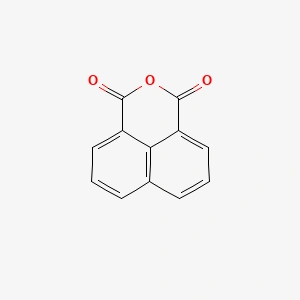
1,8-Naphthalic Anhydride

CAS No.:81-84-5
Product Grade: Industrial Grade
Purity / Assay: 98%
Molecular Formula:C₁₂H₆O₃
Molecular Weight:198.17
Synonym(s):1,8-Naphthalenedicarboxylic Anhydride; Naphthalic Anhydride; 1H,3H-Naphtho[1,8-cd]pyran-1,3-dione

1,8-Naphthalic Anhydride (CAS: 81-84-5) is a cyclic aromatic anhydride that is a key intermediate for fluorescent dyes, optical brighteners and herbicide safeners.

Its reactive anhydride ring condenses easily with amines to form naphthalimides, which are strongly fluorescent and highly stable.

Typical buyers need low acenaphthene and acid impurities to maintain colour and fluorescence quality.

It is a stable solid and should be kept dry, as moisture can open the anhydride ring. Typical checks include assay, melting point, acid value and low acenaphthene.

• Fluorescent dyes and brighteners: precursor for naphthalimide dyes used in plastics, fibres and coatings. Naphthalimides show strong blue-green fluorescence with high photostability.

• Agrochemicals: manufacture of herbicide safeners that protect crops such as sorghum and maize. The safener protects crops without reducing weed control.

• Electronic and sensor materials: building block for OLED emitters and fluorescent probes. These materials are widely studied as emitters and charge-transport layers.

• Polymer and resin modification: used in polyimide-type resins and as a curing co-reactant in heat-resistant materials.

25kg/bag, 25kg/drum
CAS No.: 81-84-5

Product Name: 1,8-Naphthalic Anhydride

Purity / Assay:98%
Molecular Formula:C₁₂H₆O₃
Molecular Weight:198.17
Synonym(s):1,8-Naphthalenedicarboxylic Anhydride; Naphthalic Anhydride; 1H,3H-Naphtho[1,8-cd]pyran-1,3-dione

1,8-Naphthalic Anhydride (CAS: 81-84-5) is a cyclic aromatic anhydride that is a key intermediate for fluorescent dyes, optical brighteners and herbicide safeners.

Its reactive anhydride ring condenses easily with amines to form naphthalimides, which are strongly fluorescent and highly stable.

Typical buyers need low acenaphthene and acid impurities to maintain colour and fluorescence quality.

It is a stable solid and should be kept dry, as moisture can open the anhydride ring. Typical checks include assay, melting point, acid value and low acenaphthene.

For global customers, we provide complete technical documentation to support product evaluation, regulatory compliance and safe handling during transportation and application.

REQUEST A QUOTE

Product Inquiry — Popup Form