
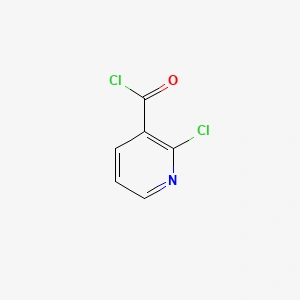
2-Chloronicotinoyl chloride
2-Chloronicotinoyl chloride, identified by CAS number 49609-84-9, is a highly reactive organic intermediate belonging to the pyridine carboxylic acid chloride family. It typically appears as a colorless to pale yellow liquid or low-melting solid and is characterized by its distinct pungent odor. As an acyl halide, it serves as a versatile building block in organic synthesis, particularly where the introduction of a 2-chloronicotinoyl moiety is required. Its chemical structure, featuring both a chlorine atom at the 2-position and a reactive acid chloride group, makes it a strategic precursor for more complex nitrogen-containing heterocycles.
In industrial and research environments, this compound is valued for its ability to undergo nucleophilic substitution reactions with various amines, alcohols, and other nucleophiles. Due to its high reactivity and sensitivity to moisture, it must be handled with significant care, typically under anhydrous conditions or inert atmospheres to prevent hydrolysis back into 2-chloronicotinic acid. Proper storage in tightly sealed containers is essential to maintain its purity and efficacy for downstream chemical transformations.
• Pharmaceutical Synthesis: This compound is a critical intermediate in the production of various active pharmaceutical ingredients (APIs). It is most notably utilized in the synthesis of non-nucleoside reverse transcriptase inhibitors (NNRTIs) like nevirapine, as well as certain non-steroidal anti-inflammatory drugs (NSAIDs) such as niflumic acid and its derivatives. The presence of the pyridine ring and the reactive acyl chloride functionality allows for the efficient construction of the complex heterocyclic frameworks often required in medicinal chemistry.
• Agrochemical Development: Within the agrochemical sector, 2-chloronicotinoyl chloride serves as a foundational building block for the synthesis of herbicides and fungicides. Its ability to be converted into various amides and esters enables researchers to fine-tune the biological activity and systemic properties of crop protection agents. The pyridine core is a common motif in modern pesticides, making this intermediate highly relevant for developing next-generation agricultural solutions.
• Heterocyclic Chemistry Research: Beyond specific industrial applications, the compound is widely employed in laboratory settings for the synthesis of diverse pyridine-based heterocyclic systems. It acts as a versatile reagent for acylation reactions, facilitating the preparation of nicotinamides and nicotinic esters that serve as precursors for more intricate molecular architectures. Its dual functionalization potential—at both the carbonyl and the 2-position of the pyridine ring—offers unique pathways for site-specific chemical modifications in advanced materials science.
Product Name: 2-Chloronicotinoyl chloride
For global customers, we provide complete technical documentation to support product evaluation, regulatory compliance and safe handling during transportation and application.