
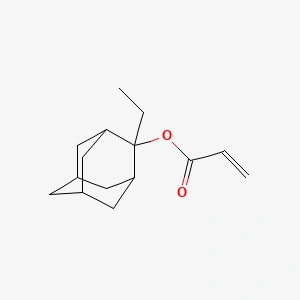
2-Ethyl-2-adamantyl acrylate
2-Ethyl-2-adamantyl acrylate, identified by CAS 303186-14-3, is a high-performance specialty monomer characterized by its bulky, tricyclic adamantane framework. This chemical structure features an acrylate group attached to a tertiary carbon center on the adamantyl cage, which also bears an ethyl substituent. The combination of the rigid adamantane moiety and the reactive acrylate functionality results in a monomer that provides exceptional thermal stability and high glass transition temperatures when incorporated into polymer chains. Its unique molecular architecture is specifically designed to balance hydrophobicity with precise chemical reactivity.
In industrial and research settings, this compound is recognized for its role in creating materials with superior mechanical and optical properties. The tertiary ester linkage is particularly significant, as it confers acid-labile characteristics to the resulting polymers, making them sensitive to specific chemical triggers. Due to its reactive nature, the material is typically handled with stabilizers and stored under controlled conditions to prevent spontaneous polymerization, ensuring its performance remains consistent for high-precision manufacturing processes.
• The most prominent application of 2-ethyl-2-adamantyl acrylate is in the semiconductor industry, where it serves as a fundamental building block for 193 nm (ArF) photoresist formulations. The acid-sensitive nature of its tertiary ester group allows for high-resolution patterning by enabling a solubility shift in the polymer matrix upon exposure to deep-ultraviolet light and acid catalysts.
• This monomer is utilized to significantly enhance the plasma etch resistance of polymeric thin films. The carbon-rich adamantyl cage provides a robust physical barrier that protects micro-circuitry during the aggressive dry etching processes required for modern integrated circuit fabrication, ensuring high-fidelity pattern transfer.
• In the field of advanced materials science, it is employed to synthesize copolymers with elevated glass transition temperatures and improved thermal durability. The rigid structure of the adamantane group restricts molecular motion within the polymer backbone, making it ideal for applications that demand dimensional stability under thermal stress.
• It is also researched for use in the development of specialized optical coatings and hydrophobic surface treatments. The bulky, non-polar adamantyl group contributes to low surface energy and specific refractive index characteristics, which are advantageous for creating protective layers in optoelectronic devices and moisture-resistant industrial coatings.
Product Name: 2-Ethyl-2-adamantyl acrylate
For global customers, we provide complete technical documentation to support product evaluation, regulatory compliance and safe handling during transportation and application.