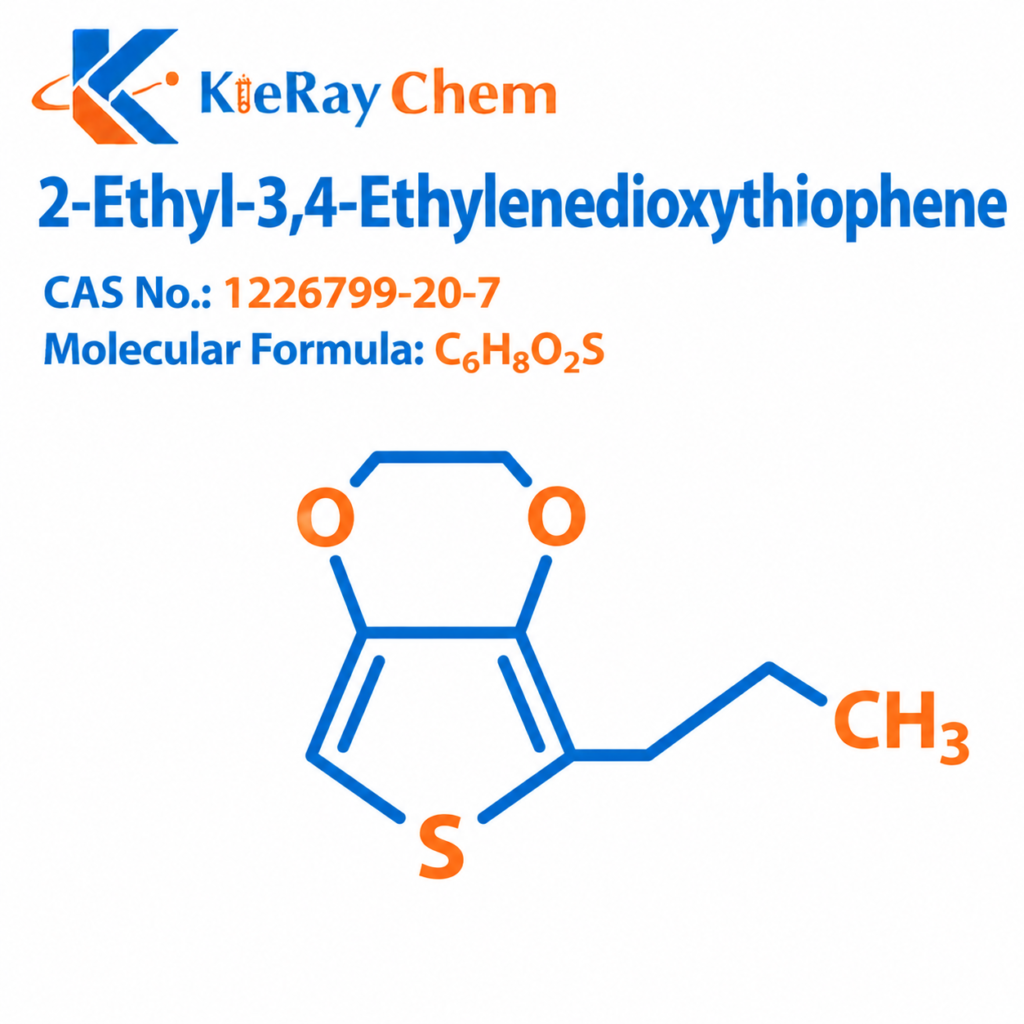
## 2-Ethyl-3,4-Ethylenedioxythiophene (2-Ethyl EDOT, CAS 1226799-20-7): Key Functions and Uses
1. **Functionalized EDOT Monomer**
2-Ethyl-3,4-Ethylenedioxythiophene, also known as **2-Ethyl EDOT**, is a functionalized thiophene monomer used in advanced polymer and materials research. Its conjugated thiophene structure enables polymerization into electrically active materials.
2. **Building Block for Conductive Polymers**
The compound is primarily used as a building block for producing **conductive EDOT-based polymers**, including poly(3,4-ethylenedioxythiophene) derivatives and poly(2-ethyl-3,4-ethylenedioxythiophene). The ethyl substituent can help researchers modify polymer structure and material properties.
3. **Electronic and Optoelectronic Materials**
CAS 1226799-20-7 is relevant to the development of organic electronic materials, functional thin films, flexible electronics, and printed electronic components. Polymer derivatives may be evaluated for conductivity, optical response, film formation, and environmental stability.
4. **Organic Photovoltaic Research**
2-Ethyl EDOT may be used in research on **organic photovoltaic cells and solar-energy materials**. Its polymerizable structure supports the design of conjugated polymers for charge transport, electrode modification, and solution-processed functional layers.
5. **OLED and Electrochromic Device Development**
EDOT-based polymers are widely investigated for organic light-emitting devices, electrochromic displays, smart windows, and related optoelectronic technologies. 2-Ethyl EDOT can serve as a monomer for exploring polymers with tailored optical, electronic, and processing characteristics.
6. **Sensors and Bioelectronic Materials**
Conductive polymers derived from EDOT monomers may be applied in chemical sensors, biosensors, electrochemical interfaces, and flexible bioelectronics. Their electrical response and surface properties can be adjusted through molecular design, polymerization conditions, and functional-group selection.
7. **Energy Storage and Electrochemical Research**
2-Ethyl EDOT is also relevant to research involving supercapacitors, battery interfaces, electrochemical coatings, and energy-storage materials. Conductive polymer derivatives may support charge transfer, electrode modification, and the development of flexible or lightweight devices.
8. **Quality, Procurement, and Safe Handling**
When sourcing 2-Ethyl-3,4-Ethylenedioxythiophene 1226799-20-7, buyers should confirm chemical identity, purity, inhibitor status, water content, appearance, packaging, storage temperature, certificate of analysis, and polymerization-control requirements. Useful SEO keywords include **2-Ethyl EDOT, CAS 1226799-20-7, conductive polymer monomer, EDOT derivative, PEDOT material, organic electronics, organic photovoltaic material, OLED research, and electrochromic polymer**. This product is intended for qualified research and industrial development; users should follow the supplier’s Safety Data Sheet and validated handling procedures.