
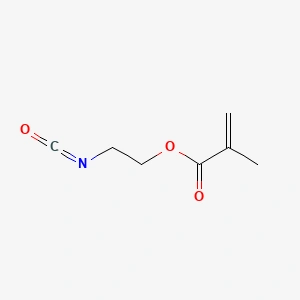
2-Isocyanatoethyl Methacrylate
2-Isocyanatoethyl Methacrylate, identified by CAS number 30674-80-7, is a sophisticated heterobifunctional monomer that integrates both a reactive isocyanate group and a polymerizable methacrylate group within a single molecule. This dual functionality makes it an invaluable tool for chemical synthesis, allowing for the precise modification of polymers and the creation of hybrid materials that combine the characteristics of polyurethanes and polyacrylates. The compound typically appears as a clear, colorless to slightly yellowish liquid and is highly regarded for its versatility in creating reactive intermediates.
In industrial and research contexts, the handling of this monomer requires careful attention due to its high reactivity toward moisture and heat. It is primarily used to introduce ethylenic unsaturation into molecules containing active hydrogen atoms, such as alcohols, amines, or carboxylic acids. By facilitating the synthesis of tailored resins and functionalized surfaces, it enables the development of high-performance materials with enhanced mechanical properties and chemical resistance, serving as a cornerstone for innovation in advanced polymer science.
• This monomer is widely utilized as a functionalizing agent to attach methacrylate groups to diverse polymer backbones and substrates. By reacting the isocyanate moiety with active hydrogen-containing compounds like polyols, it creates macromonomers that are capable of subsequent radical polymerization or UV-curing, providing a pathway for highly customized material architectures.
• In the formulation of advanced coatings and adhesives, 2-Isocyanatoethyl Methacrylate is employed to develop dual-cure systems. These systems leverage both the moisture-curing properties of isocyanates and the rapid radiation-curing capabilities of methacrylates, resulting in products with exceptional adhesion, durability, and resistance to environmental degradation.
• The compound is instrumental in the production of specialty contact lenses and hydrogels, where it acts as a cross-linking agent or a modifier to tune oxygen permeability and water content. Its ability to bridge different chemical functionalities allows for the design of materials that meet the rigorous physical and optical requirements of the ophthalmic industry.
• It is frequently used for surface modification and the improvement of interfacial bonding in composite materials. By grafting the monomer onto fibers or fillers, manufacturers can significantly enhance the compatibility between organic polymers and inorganic reinforcements, leading to superior structural integrity in high-stress applications.
Product Name: 2-Isocyanatoethyl Methacrylate
For global customers, we provide complete technical documentation to support product evaluation, regulatory compliance and safe handling during transportation and application.