
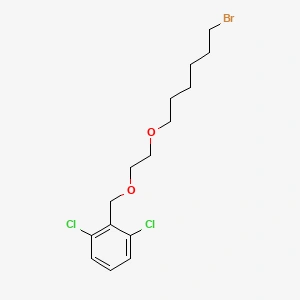
2-oxy)ethoxy)methyl)-1,3-dichlorobenzene
CAS 503070-57-3, chemically identified as 2-((2,6-dichlorobenzyl)oxy)ethanol, is a specialized halogenated aromatic ether that serves as a versatile building block in organic synthesis. The molecule features a 1,3-dichlorobenzene ring system connected via a methylene bridge to a 2-hydroxyethoxy group, providing a unique combination of a stable aromatic core and a reactive primary alcohol functionality. This structural arrangement is particularly valuable in research and industrial chemistry for the development of complex derivatives where specific steric and electronic properties are required. The presence of chlorine atoms at the ortho positions relative to the ether linkage imparts significant chemical characteristics that influence the reactivity of the adjacent functional groups. As a high-value raw material, it is handled with standard precautions for halogenated organic compounds, ensuring stability and integrity during synthetic procedures. Its role as a precursor allows for the precise construction of molecular frameworks in various specialty chemical sectors, making it an essential component for advanced laboratory applications.
• Synthetic Intermediate: This compound functions as a critical intermediate in the synthesis of diverse chemical entities. The primary alcohol moiety facilitates further functionalization through esterification, etherification, or oxidation, while the dichlorobenzene scaffold remains a robust structural component throughout multi-step organic transformations.
• Specialty Chemical Development: It is utilized in the production of specialty chemicals where a 2,6-dichlorophenyl motif is required. This specific substitution pattern is often sought after in the development of materials with tailored physical properties, such as specific refractive indices or enhanced thermal stability, making it useful in polymer science and performance coatings.
• Agrochemical and Pharmaceutical Research: Within research and development frameworks, CAS 503070-57-3 acts as a precursor for bioactive molecules. The halogenated aromatic structure is a common pharmacophore or auxophore in agrochemical design, particularly in the creation of herbicides or fungicides, where the chlorine substituents play a vital role in biological activity and metabolic stability.
• Molecular Probes and Linkers: The molecule’s unique ether-linked hydroxyl group enables its incorporation into molecular probes or as a linker in conjugation chemistry. Its structural rigidity and lipophilic character can be exploited to modify the pharmacokinetic or physicochemical properties of larger molecular assemblies in analytical and diagnostic applications.
Product Name: 2-oxy)ethoxy)methyl)-1,3-dichlorobenzene
For global customers, we provide complete technical documentation to support product evaluation, regulatory compliance and safe handling during transportation and application.