
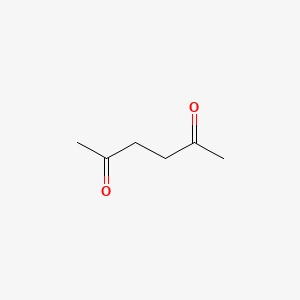
2,5-Hexanedione, commonly referred to as acetonylacetone, is a clear to light yellow liquid organic compound belonging to the 1,4-diketone family. Identified by CAS number 110-13-4, this versatile chemical serves as a critical building block in organic chemistry due to its distinct bifunctional structure. It exhibits high solubility in both water and common organic solvents, making it an adaptable reagent for various liquid-phase reactions. Its chemical stability under standard conditions allows for effective storage, though it should be handled with care in well-ventilated environments.
In industrial and research settings, 2,5-hexanedione is valued primarily for its reactivity in cyclization processes. It acts as a pivotal intermediate for the synthesis of five-membered heterocyclic compounds, which are essential in the development of pharmaceuticals, agrochemicals, and specialty dyes. Beyond its role as a precursor, it serves as a specialized solvent and a cross-linking agent in certain polymer applications. Its unique position as a metabolic byproduct of n-hexane also makes it a significant subject of study in toxicological research and occupational health monitoring.