
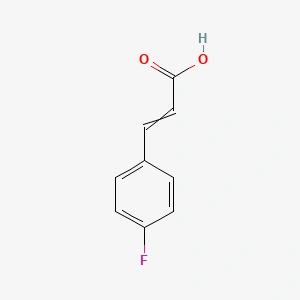
3-(4-fluorophenyl)-2-propenoic acid, also widely recognized as 4-fluorocinnamic acid, is an organic compound characterized by its cinnamic acid backbone with a fluorine substituent at the para position of the benzene ring. This white to off-white crystalline solid serves as a versatile building block in synthetic chemistry, owing to the presence of both an alpha, beta-unsaturated carboxylic acid group and a halogenated aromatic ring. The electron-withdrawing nature of the fluorine atom significantly influences the reactivity and physicochemical properties of the molecule compared to its non-halogenated counterparts.
In research and industrial contexts, this compound is valued for its role as a precursor in the development of various fine chemicals and bioactive molecules. Its stable structure allows for diverse chemical transformations, including esterification, hydrogenation, and coupling reactions. Proper handling involves standard laboratory safety protocols, as it is generally categorized as an irritant. As a high-purity intermediate, it is essential for laboratories focused on medicinal chemistry and advanced materials development.