
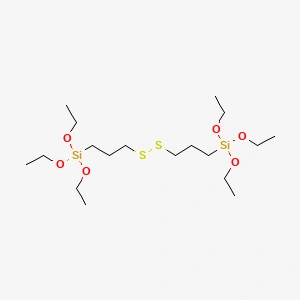
3,14-Dioxa-8,9-dithia-4,13-disilahexadecane, 4,4,13,13-tetraethoxy-
CAS 56706-10-6, chemically identified as 3,14-dioxa-8,9-dithia-4,13-disilahexadecane, 4,4,13,13-tetraethoxy-, is a bifunctional organosilane widely utilized as a coupling agent in the polymer and rubber industries. This molecule features a disulfide bridge flanked by triethoxysilyl groups, allowing it to bridge the gap between inorganic fillers and organic elastomer matrices. As a clear to slightly yellowish liquid, it exhibits reactivity towards hydroxyl groups on mineral surfaces through hydrolysis, while the sulfur moiety participates in the vulcanization process of unsaturated polymers. Proper handling requires protection from moisture to prevent premature hydrolysis and polymerization. In industrial contexts, it is valued for its ability to enhance physical properties such as tensile strength, abrasion resistance, and modulus. Its role as a processing aid and reinforcing agent makes it indispensable for high-performance composite materials where interfacial adhesion is critical for durability and efficiency. As a research raw material, it serves as a precursor for developing advanced functionalized surfaces and hybrid materials, offering precise control over sulfur-silane chemistry.
• In the tire and rubber manufacturing sector, this organosilane acts as a vital coupling agent for silica-reinforced compounds. By chemically bonding the silica filler to the hydrocarbon polymer chains during the vulcanization process, it significantly reduces rolling resistance and improves wet grip performance. This application is essential for producing energy-efficient tires that maintain high levels of durability and safety under diverse road conditions.
• The compound is extensively employed in the production of technical rubber goods, including conveyor belts, hoses, and shoe soles. It enhances the dispersion of mineral fillers like clay, talc, and silica within the elastomer matrix, leading to improved mechanical properties such as tear strength and heat resistance. This improved filler-polymer interaction ensures that the final products can withstand rigorous mechanical stress and environmental exposure in industrial environments.
• Beyond traditional rubber applications, CAS 56706-10-6 is utilized in the formulation of specialty coatings and sealants. It functions as an adhesion promoter, facilitating strong bonds between organic resins and inorganic substrates like glass or metal. The disulfide linkage provides unique chemical reactivity that can be leveraged to create crosslinked networks with specific thermal and chemical stability, making it a versatile component in the development of advanced hybrid materials and protective surface treatments.
Product Name: 3,14-Dioxa-8,9-dithia-4,13-disilahexadecane, 4,4,13,13-tetraethoxy-
For global customers, we provide complete technical documentation to support product evaluation, regulatory compliance and safe handling during transportation and application.