
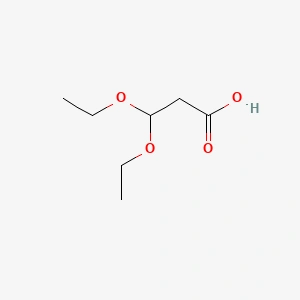
3,3-Diethoxypropionic acid
3,3-Diethoxypropionic acid, identified by CAS number 6191-97-5, is a versatile organic building block characterized by its dual functional nature. As an acetal-protected derivative of malonaldehydic acid, it features both a carboxylic acid group and a diethyl acetal moiety. This unique structure allows for selective reactivity, where the acid group can participate in esterification or amidation while the acetal remains stable under basic or neutral conditions, serving as a masked aldehyde for subsequent deprotection.
In industrial and research settings, this compound is valued for its stability and ease of handling compared to its free aldehyde counterparts. It typically appears as a clear to pale yellow liquid and is soluble in various organic solvents. Its role as a bifunctional reagent makes it an essential component in the construction of complex molecular frameworks, particularly in the fine chemical and specialty synthesis sectors.
• Serving as a critical intermediate in the synthesis of heterocyclic compounds, 3,3-Diethoxypropionic acid is frequently employed in the construction of various nitrogen-containing rings. The masked aldehyde functionality allows for controlled cyclization reactions, which are vital for producing specialty chemicals used in advanced materials and agricultural research.
• The compound is widely utilized in the preparation of specialized esters and amides where a terminal aldehyde group is required in the final structure. By utilizing the acetal protection, chemists can perform complex modifications on the carboxylic acid end without risking polymerization or unwanted side reactions at the aldehyde site, ensuring higher yields and purity.
• In the field of organic synthesis, it acts as a three-carbon synthon for the introduction of formyl-ethyl groups. This application is particularly useful in the development of fragrance components and flavor additives, where the precise arrangement of functional groups dictates the organoleptic properties of the resulting molecules.
• It is also applied as a reagent in the modification of polymers and surfaces. The ability to deprotect the acetal to a reactive aldehyde under mild acidic conditions provides a pathway for functionalizing substrates with specific ligands or cross-linking agents, facilitating the creation of tailored chemical environments.
Product Name: 3,3-Diethoxypropionic acid
For global customers, we provide complete technical documentation to support product evaluation, regulatory compliance and safe handling during transportation and application.