
English | 中文 | Español

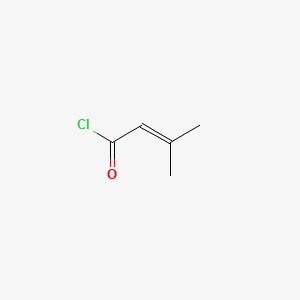
3,3-Dimethylacryloyl Chloride

CAS No.:3350-78-5
Product Grade: Industrial Grade
Purity / Assay: 98%
Molecular Formula:C₅H₇ClO
Molecular Weight:118.56
EINECS No.:222-109-4
Synonym(s):3-Methylcrotonoyl Chloride; 3-Methyl-2-Butenoyl Chloride; Dimethylacryloyl Chloride

3,3-Dimethylacryloyl chloride is the acid chloride of 3-methyl-2-butenoic acid, supplied as a colourless to pale yellow clear liquid at 98% purity.

The molecule contains both a highly electrophilic acyl chloride and an activated, trisubstituted double bond, which makes it a compact bifunctional reagent for introducing the 3-methyl-2-butenoyl (senecioyl) group. Acylation reactions proceed rapidly under mild conditions, with hydrogen chloride as the only by-product.

The liquid is corrosive and moisture-sensitive, evolving hydrogen chloride on contact with water, and it must be stored under dry inert gas in corrosion-resistant containers away from bases, alcohols and oxidising agents.

• Acylation of amines and alcohols: builds senecioyl amides and esters, including pharmaceutical and agrochemical intermediates bearing the dimethylacrylate motif.

• Polymer and monomer synthesis: used to prepare unsaturated esters and amides that undergo later addition or polymerisation.

• Peroxide and initiator chemistry: an intermediate for peroxy esters and functional acyl derivatives used in polymerisation initiation.

• Fine chemical synthesis: applied in the regioselective protection or functionalisation of polyols, amino alcohols and heterocyclic scaffolds.

25kg/drum, 200kg/drum
CAS No.: 3350-78-5

Product Name: 3,3-Dimethylacryloyl Chloride

Purity / Assay:98%
Molecular Formula:C₅H₇ClO
Molecular Weight:118.56
EINECS No.:222-109-4
Synonym(s):3-Methylcrotonoyl Chloride; 3-Methyl-2-Butenoyl Chloride; Dimethylacryloyl Chloride

3,3-Dimethylacryloyl chloride is the acid chloride of 3-methyl-2-butenoic acid, supplied as a colourless to pale yellow clear liquid at 98% purity.

The molecule contains both a highly electrophilic acyl chloride and an activated, trisubstituted double bond, which makes it a compact bifunctional reagent for introducing the 3-methyl-2-butenoyl (senecioyl) group. Acylation reactions proceed rapidly under mild conditions, with hydrogen chloride as the only by-product.

The liquid is corrosive and moisture-sensitive, evolving hydrogen chloride on contact with water, and it must be stored under dry inert gas in corrosion-resistant containers away from bases, alcohols and oxidising agents.

For global customers, we provide complete technical documentation to support product evaluation, regulatory compliance and safe handling during transportation and application.

REQUEST A QUOTE

Product Inquiry — Popup Form