
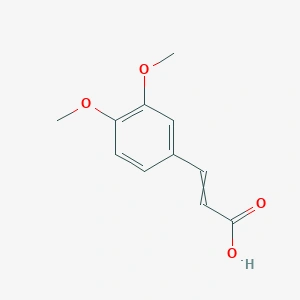
3′,4′-Dimethoxycinnamic acid
3′,4′-Dimethoxycinnamic acid, also identified by CAS number 2316-26-9, is a naturally occurring phenolic acid derivative and a methylated analogue of caffeic acid. It typically appears as a white to pale yellow crystalline powder. As a member of the phenylpropanoid family, this compound features a cinnamic acid backbone with two methoxy groups at the 3 and 4 positions of the benzene ring. This specific substitution pattern influences its solubility and reactivity compared to other hydroxycinnamic acids, making it a valuable building block in various chemical synthesis pathways.
In laboratory and industrial settings, this compound is handled as a stable organic intermediate. It serves as a precursor for the synthesis of more complex bioactive molecules and functional materials. Due to its structural relationship with dietary polyphenols, it is frequently utilized in research focusing on phytochemical properties and metabolic pathways. Proper handling involves standard laboratory safety protocols, ensuring the material is stored in a cool, dry environment to maintain its chemical integrity over time.
• In the field of organic synthesis, 3′,4′-Dimethoxycinnamic acid serves as a critical intermediate for the preparation of various pharmaceutical compounds and fine chemicals. It is frequently employed in the synthesis of lignans, alkaloids, and other complex natural product analogues. The presence of the dimethoxy substitution provides a specific electronic environment that facilitates regioselective reactions, allowing chemists to construct diverse molecular architectures for drug discovery and development.
• This compound is widely utilized in biochemical and pharmacological research as a reference standard and a substrate for enzymatic studies. Researchers investigate its role in metabolic processes, particularly concerning the methylation and demethylation pathways of phenolic acids. Its structural similarity to caffeic acid allows it to be used in comparative studies regarding antioxidant activity, enzyme inhibition, and the modulation of cellular signaling pathways in vitro.
• Within the fragrance and flavor industry, 3′,4′-Dimethoxycinnamic acid and its derivatives are explored for their aromatic properties. While not as common as simple cinnamic acid, its unique substitution pattern contributes to the development of specific scent profiles and flavoring agents. It acts as a precursor for various esters and aldehydes that are used to enhance the sensory characteristics of consumer products, ranging from cosmetics to specialty food additives.
Product Name: 3′,4′-Dimethoxycinnamic acid
For global customers, we provide complete technical documentation to support product evaluation, regulatory compliance and safe handling during transportation and application.