
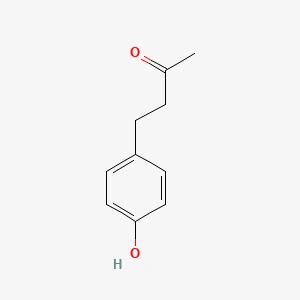
4-(4′-Hydroxyphenyl)-2-butanone
4-(4′-Hydroxyphenyl)-2-butanone, widely recognized by the common name raspberry ketone, is a naturally occurring phenolic compound primarily responsible for the characteristic aroma of red raspberries. Chemically, it is an aromatic ketone consisting of a butanone chain substituted with a para-hydroxyphenyl group. In its pure form, it appears as a white to off-white crystalline solid or powder, exhibiting a distinctively sweet, fruity, and berry-like scent profile that is highly sought after in various chemical sectors.
This compound serves as a critical raw material and intermediate in organic synthesis due to its functional phenolic and ketonic groups. It is valued for its stability and compatibility with a wide range of other aromatic ingredients. When handling this material, it is important to maintain standard laboratory safety protocols, ensuring storage in tightly sealed containers away from direct sunlight and moisture to prevent degradation. Its role extends beyond simple flavoring, acting as a structural building block for more complex chemical derivatives in research and industrial applications.
• In the flavor and fragrance industry, 4-(4′-Hydroxyphenyl)-2-butanone is extensively utilized as a primary aromatic component to replicate the natural scent and taste of red raspberries and other berries. Its potent organoleptic profile makes it a staple ingredient in the formulation of food-grade essences, beverages, and confectionery products where a sweet, fruity character is desired.
• The compound is a popular additive in the cosmetic and personal care sectors, where it is incorporated into perfumes, lotions, shampoos, and soaps. Its ability to provide a long-lasting, pleasant fragrance at low concentrations makes it an efficient choice for enhancing the sensory appeal of high-end skincare and toiletry formulations.
• Beyond its aromatic applications, this phenolic ketone serves as a versatile chemical intermediate in organic synthesis. Researchers and industrial chemists use it as a starting material for the production of more complex molecules, including various pharmaceutical precursors and specialty chemicals that require a p-substituted phenol moiety.
• It is also employed in analytical chemistry and biochemical research as a reference standard for the identification and quantification of phenolic compounds in botanical extracts. Its well-defined chemical structure allows it to be used in studies focusing on enzymatic reactions, metabolic pathways, and the development of new synthetic methodologies.
Product Name: 4-(4′-Hydroxyphenyl)-2-butanone
For global customers, we provide complete technical documentation to support product evaluation, regulatory compliance and safe handling during transportation and application.