
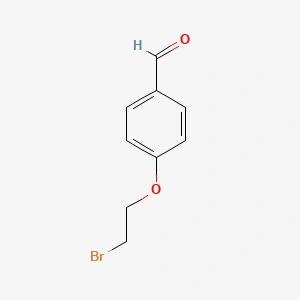
4-benzaldehyde
4-(Diphenylamino)benzaldehyde, identified by CAS 52191-15-8, is a significant organic building block characterized by its triphenylamine core substituted with a formyl group at the para-position. This compound typically appears as a yellow to orange crystalline powder and is prized in materials science for its unique optoelectronic properties. The presence of the tertiary amine group imparts electron-donating characteristics, while the aldehyde functionality provides a versatile site for further chemical transformations, such as Wittig reactions or condensation processes. In an industrial and research context, it serves as a critical intermediate for synthesizing functional dyes, hole-transport materials, and fluorescent probes. Due to its chemical reactivity, handling should be conducted within a controlled laboratory environment using appropriate personal protective equipment to prevent irritation. Its high purity and structural stability make it an essential raw material for developing advanced organic electronics, including organic light-emitting diodes (OLEDs) and solar cell components, where precise molecular architecture is paramount for performance.
• Used extensively as a key intermediate in the synthesis of organic optoelectronic materials, particularly for the development of hole-transporting layers (HTLs) in organic light-emitting diodes (OLEDs) and perovskite solar cells. The triphenylamine moiety facilitates efficient charge carrier mobility, which is essential for improving the power conversion efficiency and operational stability of these next-generation electronic devices.
• Serves as a versatile precursor in the production of functional fluorescent dyes and chemosensors. By undergoing condensation reactions with various active methylene compounds or amines, it enables the creation of extended pi-conjugated systems. These derivatives are frequently employed in bioimaging and analytical chemistry to detect specific metal ions or environmental changes through distinct fluorometric or colorimetric responses.
• Functions as a building block for the synthesis of non-linear optical (NLO) materials and photochromic compounds. The push-pull electronic structure created by the electron-donating diphenylamino group and the electron-withdrawing aldehyde (or its derivatives) allows for the fine-tuning of molecular hyperpolarizability. This makes it valuable for applications in optical signal processing, high-density data storage, and the fabrication of advanced photonic devices requiring precise light modulation capabilities.
Product Name: 4-benzaldehyde
For global customers, we provide complete technical documentation to support product evaluation, regulatory compliance and safe handling during transportation and application.