
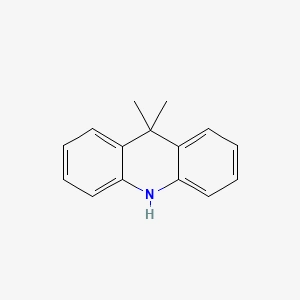
9,9-Dimethyl-10H-acridine, commonly known as a substituted acridan, is a specialized organic building block characterized by its rigid heterocyclic structure. With the CAS registry number 6267-02-3, this compound features a central acridine framework where the 9-position is substituted with two methyl groups, significantly influencing its conformational and electronic properties. It typically appears as a white to off-white crystalline solid and is valued for its high purity and thermal stability in advanced chemical syntheses.
In a research and industrial context, this material serves as a crucial electron-donating moiety. Its unique structural geometry allows for the fine-tuning of molecular orbitals when incorporated into larger conjugated systems. Handling this chemical requires standard laboratory precautions, including the use of personal protective equipment and storage under inert conditions to maintain its integrity. Its value lies primarily in its role as a precursor for high-performance functional materials used in modern optoelectronics.