
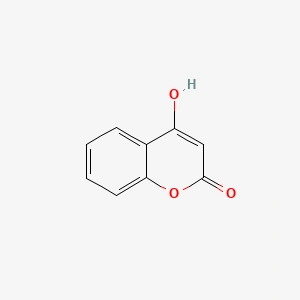
Benzotetronic acid, also widely known as 4-hydroxycoumarin, is a significant organic compound characterized by its bicyclic structure consisting of a benzene ring fused to a lactone ring with a hydroxyl group at the 4-position. It typically appears as a white to pale yellow crystalline powder. This compound serves as a vital building block in organic chemistry due to its unique reactivity, particularly its ability to undergo electrophilic substitution and condensation reactions at the 3-position.
In industrial and research environments, benzotetronic acid is prized for its role as a versatile intermediate. It is stable under standard storage conditions but should be handled with care using appropriate personal protective equipment to prevent dust inhalation or skin irritation. Its utility spans across multiple sectors, primarily serving as the foundational scaffold for the synthesis of various bioactive molecules and specialized industrial chemicals.