
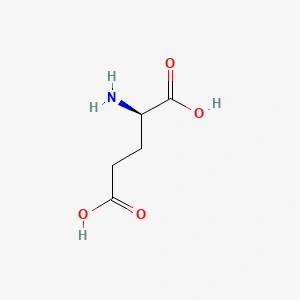
D-Glutamic acid, identified by CAS number 6893-26-1, is the dextrorotatory enantiomer of the common proteinogenic amino acid L-glutamic acid. Unlike its more prevalent L-isomer, D-Glutamic acid is a non-proteinogenic amino acid that plays a specialized role in nature, most notably as a structural component in the peptidoglycan layer of bacterial cell walls. This distinct biological presence makes it an essential tool for microbiological research and the study of bacterial cell wall synthesis. The compound typically appears as a white to off-white crystalline powder and exhibits high purity and stability when stored under standard laboratory conditions.
In industrial and research contexts, D-Glutamic acid is valued for its unique stereochemistry and chemical versatility. It serves as a critical chiral building block for the synthesis of specialized chemical derivatives and bioactive molecules. Because it is not readily metabolized by standard eukaryotic pathways, it is frequently utilized in the development of metabolic probes and stable peptide analogs. Its role as a fundamental intermediate allows researchers to explore complex enzymatic reactions and develop novel compounds for various scientific applications.