
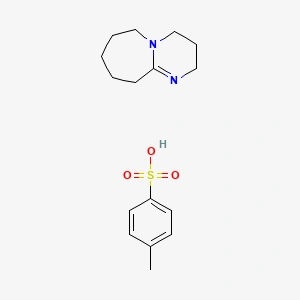
DBU p-Toluenesulfonate
DBU p-Toluenesulfonate, identified by CAS number 51376-18-2, is a specialized organic salt formed through the neutralization of the bicyclic amidine 1,8-diazabicyclo[5.4.0]undec-7-ene (DBU) with p-toluenesulfonic acid. This compound serves as a stabilized, often latent, source of the strong, non-nucleophilic base DBU, which is highly valued in synthetic organic chemistry and polymer science. As a crystalline solid, it offers distinct handling advantages over the liquid free base, including improved shelf stability and more precise dosing in sensitive reaction environments. The p-toluenesulfonate anion modulates the reactivity of the DBU cation, allowing for controlled release or activation under specific thermal or chemical conditions. This characteristic makes it an essential raw material for researchers and industrial manufacturers seeking to optimize base-catalyzed transformations while minimizing side reactions or premature initiation. Its robust chemical profile ensures consistent performance across diverse solvent systems, reinforcing its status as a critical reagent in modern chemical synthesis and advanced material development.
• In the field of polymer chemistry, DBU p-Toluenesulfonate is extensively utilized as a latent catalyst for the curing of epoxy resins and polyurethane systems. By providing a controlled release of the DBU base, it allows for extended pot life and improved processing stability in one-component formulations, only initiating the cross-linking reaction upon the application of heat. This thermal activation mechanism is crucial for industrial coatings, adhesives, and encapsulants where precise control over the polymerization rate is necessary to ensure optimal mechanical properties and surface finish.
• The compound serves as an effective reagent in various organic synthesis protocols, particularly in reactions requiring a strong, non-nucleophilic base such as dehydrohalogenations, Michael additions, and esterifications. Its salt form facilitates easier storage and handling compared to the volatile free base, making it a preferred choice for large-scale pharmaceutical and fine chemical manufacturing. The presence of the tosylate counterion can also influence the solubility and selectivity of the base-catalyzed pathway, often leading to higher yields and reduced formation of unwanted byproducts in complex synthetic routes.
• It is frequently employed as a specialized catalyst in the production of specialty chemicals and intermediates, where its ability to promote specific molecular rearrangements is highly valued. The stability of the DBU-tosylate complex ensures that the catalytic activity remains consistent throughout the reaction cycle, even in the presence of sensitive functional groups. This reliability is essential for developing high-purity materials in the electronics and aerospace industries, where chemical consistency and predictable reaction kinetics are paramount for maintaining strict quality standards.
Product Name: DBU p-Toluenesulfonate
For global customers, we provide complete technical documentation to support product evaluation, regulatory compliance and safe handling during transportation and application.