
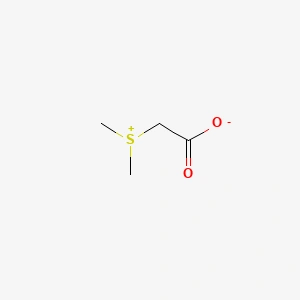
Dimethylsulfonioacetate
Dimethylsulfonioacetate, identified by CAS number 4727-41-7, is a naturally occurring sulfonium compound characterized as a zwitterionic internal salt. Also known as dimethylthetin, this organic molecule features a positively charged sulfur atom bonded to two methyl groups and a carboxymethyl group with a negative charge. It serves as a significant intermediate in sulfur metabolism and methyl group transfer reactions within various biological systems, particularly in marine organisms like algae and phytoplankton. In a laboratory or industrial context, it is typically handled as a crystalline solid with high water solubility. As a chemical raw material, dimethylsulfonioacetate is valued for its role as an efficient methyl donor in biochemical research and organic synthesis. Its unique chemical structure allows it to participate in transmethylation processes, making it a critical reagent for studying enzymatic pathways and metabolic cycles. Proper storage in cool, dry conditions is essential to maintain its stability, as it is sensitive to moisture and thermal degradation. Its utility spans across chemical biology, aquaculture research, and specialized organic manufacturing.
• Used extensively in aquaculture and marine biology research as a potent chemoattractant and feeding stimulant. Dimethylsulfonioacetate plays a crucial role in the sensory physiology of various fish and crustacean species, where it is recognized as a signal for high-nutrient environments. Researchers utilize this compound to study foraging behaviors and to develop specialized feed formulations that improve ingestion rates and overall growth performance in controlled aquatic environments.
• Functions as a vital methyl donor in biochemical and enzymatic studies. Due to the high reactivity of its sulfonium center, it serves as a substrate for methyltransferase enzymes, facilitating the transfer of methyl groups to various acceptors such as homocysteine. This makes it an indispensable tool for investigating the methionine cycle, sulfur metabolism, and the broader landscape of cellular transmethylation reactions in both prokaryotic and eukaryotic models.
• Serves as a specialized intermediate in organic synthesis and the production of sulfur-containing derivatives. Its zwitterionic nature and specific reactivity profile allow chemists to employ it in the synthesis of complex molecules requiring precise methyl or sulfur incorporation. It is particularly useful in the development of surfactants, stabilizers, and other functional chemicals where a stable yet reactive sulfonium moiety is required for specific molecular architectures.
Product Name: Dimethylsulfonioacetate
For global customers, we provide complete technical documentation to support product evaluation, regulatory compliance and safe handling during transportation and application.