
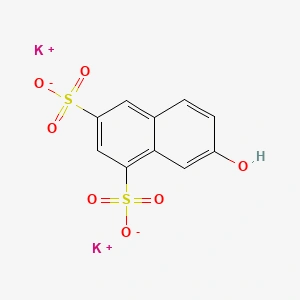
Dipotassium 2-naphthol-6,8-disulfonate
Dipotassium 2-naphthol-6,8-disulfonate, identified by CAS 842-18-2 and frequently referred to in industrial chemistry as G salt (potassium salt), is a significant sulfonated naphthalene derivative. As a white to off-white crystalline powder, this compound exhibits high water solubility and stability under standard storage conditions. Chemically, it consists of a naphthalene ring substituted with a hydroxyl group at the 2-position and two sulfonic acid potassium salt groups at the 6 and 8 positions. This specific substitution pattern makes it a versatile intermediate in organic synthesis. In industrial contexts, it is primarily valued for its reactivity in coupling reactions, particularly in the production of azo dyes and pigments. Proper handling requires standard laboratory safety protocols, including the use of personal protective equipment to prevent inhalation of dust or contact with skin and eyes. Its role as a building block is essential for achieving specific coloristic properties and solubility profiles in various chemical products.
• Dye and Pigment Synthesis: The primary application of dipotassium 2-naphthol-6,8-disulfonate is as a key intermediate in the manufacture of synthetic organic dyes. It serves as a coupling component in the production of various azo dyes, where its sulfonic acid groups enhance the water solubility and affinity of the resulting pigments for textile fibers.
• Chemical Intermediate: Beyond the colorant industry, this compound is utilized as a precursor for the synthesis of other naphthalene-based derivatives. Its structure allows for further functionalization, making it a valuable reagent in specialized organic chemistry research and the development of fine chemicals.
• Analytical Chemistry: It may be employed in analytical applications as a reagent or standard in the study of naphthalene sulfonates. Its well-defined chemical structure and solubility profile make it suitable for calibrating equipment or serving as a baseline in chromatographic and spectroscopic analysis of similar aromatic compounds.
• Material Science: In certain research contexts, the salt is explored for its potential in developing functional materials, such as sulfonated polymers or specialized coatings, where the naphthalene core provides structural rigidity and the sulfonate groups offer ionic conductivity or specific surface interactions.
Product Name: Dipotassium 2-naphthol-6,8-disulfonate
For global customers, we provide complete technical documentation to support product evaluation, regulatory compliance and safe handling during transportation and application.