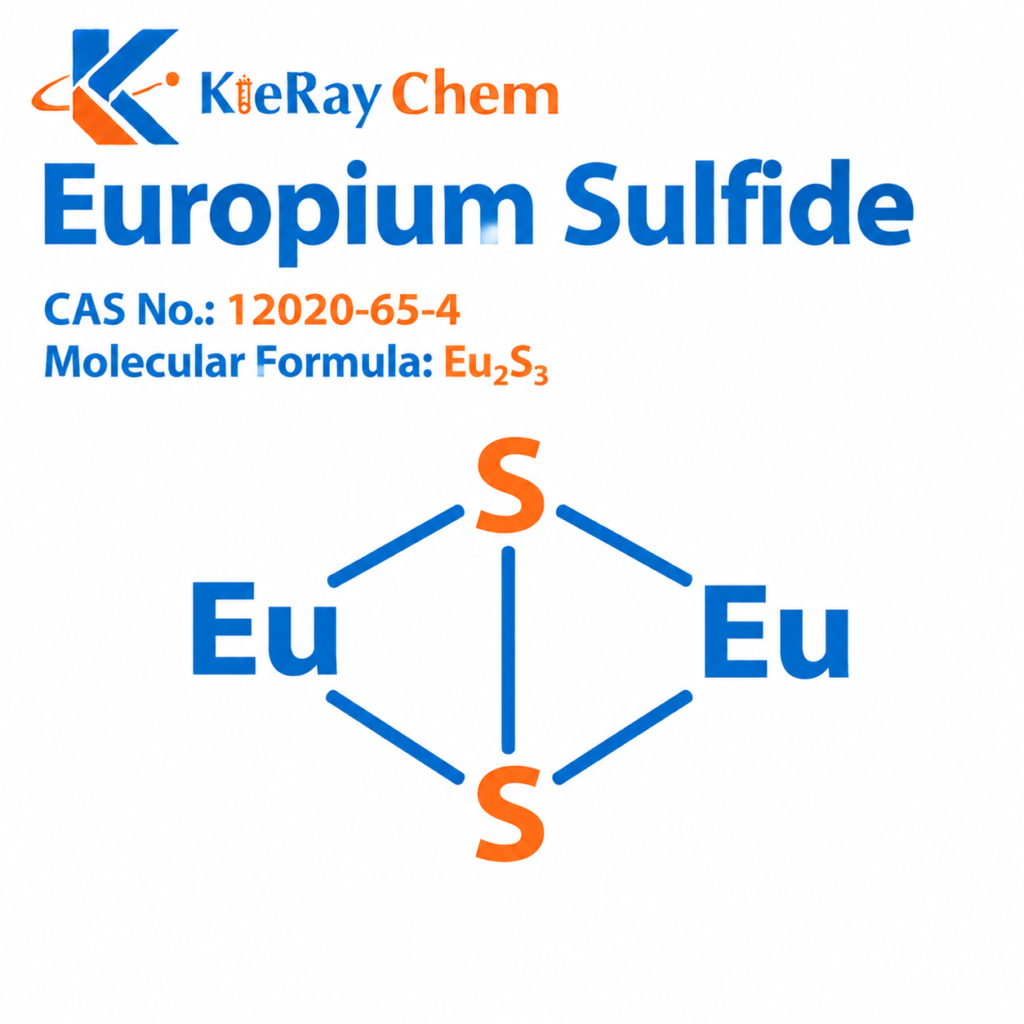
## Europium Sulfide (EuS, CAS 12020-65-4): Key Functions and Uses
1. **Magnetic Semiconductor Material**
Europium Sulfide, commonly known as **EuS**, is a europium(II) chalcogenide with distinctive magnetic and electronic properties. Its combination of semiconducting behavior and ferromagnetism makes it valuable for advanced materials research.
2. **Ferromagnetic and Spintronic Research**
EuS is studied as a ferromagnetic semiconductor for **spintronics, spin injection, magnetic tunnel junctions, and spin-dependent electronic devices**. Researchers use it to investigate the interaction between charge transport and electron spin.
3. **Magneto-Optical Applications**
The material’s magnetic and optical characteristics support research into magneto-optical devices, optical modulation, magnetic sensing, and light-controlled electronic systems. Its performance depends on crystal quality, film thickness, purity, and fabrication conditions.
4. **Magnetoresistive and Photomagnetic Materials**
Europium Sulfide can be evaluated for magnetoresistive and photomagnetic applications, where electrical or optical properties change in response to an external magnetic field or light exposure. These features are relevant to next-generation sensors and memory technologies.
5. **Optical and Infrared Materials Research**
EuS is investigated in optical materials, infrared-related devices, laser-window research, and semiconductor structures. Its electronic band structure and magnetic behavior make it a useful model material for studying light–matter and spin–charge interactions.
6. **Phosphor and Luminescent Materials Development**
Europium-containing sulfide materials may be explored in phosphor, luminescent, and optoelectronic research. Researchers can study emission behavior, energy transfer, and the effects of composition or doping on optical performance for display and lighting technologies.
7. **Solid-State Chemistry and Advanced Materials Synthesis**
CAS 12020-65-4 is used in solid-state synthesis, ceramic research, thin-film preparation, nanomaterial development, coatings, and compound-semiconductor studies. It can serve as a source of europium and sulfur when producing specialized functional materials.
8. **Quality, Procurement, and Safety Considerations**
When sourcing Europium Sulfide, buyers should confirm phase composition, purity, particle size, morphology, oxygen and moisture content, packaging, certificate of analysis, and storage requirements. Useful SEO keywords include **Europium Sulfide, Europium(II) Sulfide, EuS, CAS 12020-65-4, ferromagnetic semiconductor, spintronics material, magneto-optical material, magnetoresistive material, and optical research chemical**. This product is intended for qualified research and industrial materials development. Users should consult the supplier’s Safety Data Sheet and follow appropriate procedures for handling europium compounds and sulfide-containing materials.