
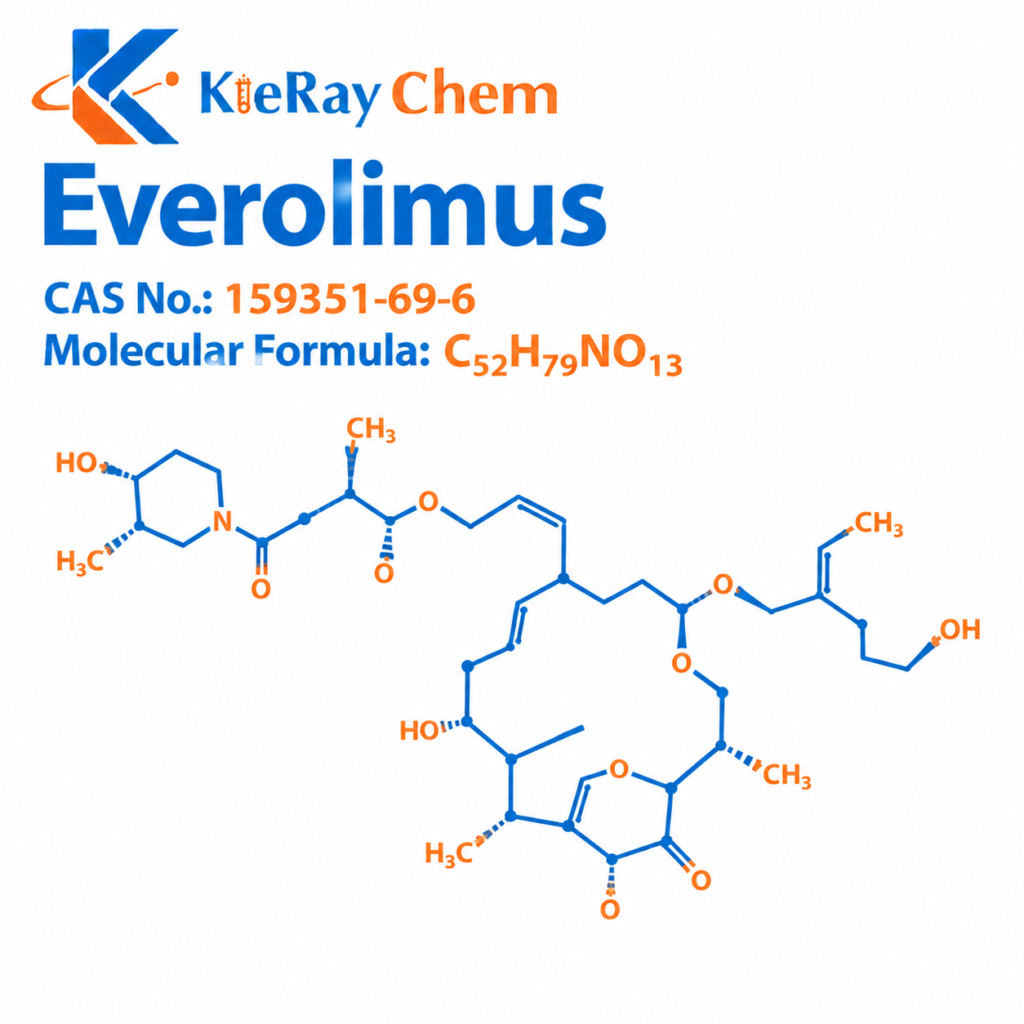
Everolimus
Everolimus (CAS:159351-69-6) is a derivative of rapamycin and a selective inhibitor of the mTOR pathway. As a pharma-grade active ingredient it is used in immunosuppression after organ transplantation, in oncology, and in drug-eluting stent coatings, with well-defined purity and impurity profiles for regulated manufacturing. As a Pharma Grade product, this material is manufactured with defined process control and released against documented specifications covering assay, impurities and physical properties, which simplifies incoming inspection for buyers. Flexible packaging options including 5kg/bag, 25kg/drum and dependable export logistics make volume sourcing straightforward, while consistent quality protects downstream process reproducibility and end-product performance.
KieRay Chem has established itself as a stable and trustworthy supplier of Everolimus (CAS:159351-69-6), combining years of manufacturing experience with rigorous quality management. Every batch is tested against tight specifications for assay, impurities and physical properties, and complete COA, technical data sheets and safety documentation are provided with each shipment. Our flexible packaging options, dependable global logistics and responsive technical support ensure that research laboratories, formulators and industrial manufacturers receive consistent material on schedule. Competitive pricing, long-term stock availability and the ability to tailor grades and pack sizes make KieRay Chem the partner of choice for sustaining uninterrupted production and product quality.
## Everolimus (CAS 159351-69-6): Key Functions and Uses
1. **Selective mTORC1 Inhibitor**
Everolimus, also known as **RAD001**, is a rapamycin derivative and a selective inhibitor of the mammalian target of rapamycin complex 1 (**mTORC1**). The mTOR pathway regulates cell growth, protein synthesis, metabolism, proliferation, and survival.
2. **Anticancer and Targeted-Therapy Applications**
Everolimus is used in oncology to help inhibit mTOR-driven tumor growth. Depending on the approved formulation and local regulations, it is used in the treatment of selected advanced cancers, including certain breast cancers, pancreatic neuroendocrine tumors, renal cell carcinoma, and other neuroendocrine or solid tumors.
3. **Treatment of Specific Tuberous Sclerosis Complex Conditions**
Everolimus is also used for certain manifestations associated with **tuberous sclerosis complex (TSC)**. By suppressing abnormal mTOR signaling, it may help reduce the growth or progression of selected TSC-related tumors and lesions under specialist medical supervision.
4. **Immunosuppressive Function in Transplant Medicine**
In specific pharmaceutical formulations, everolimus is used as an immunosuppressant to help prevent organ rejection after transplantation. It reduces the activation and proliferation of immune cells, but treatment requires careful monitoring by qualified healthcare professionals.
5. **Research on Cell Growth and Signal Transduction**
Everolimus is widely used as a research tool for studying mTOR signaling, autophagy, cell-cycle regulation, metabolism, angiogenesis, apoptosis, and cancer biology. It can help researchers investigate the relationship between mTORC1 activity and cellular responses.
6. **Pharmacology and Drug-Development Research**
CAS 159351-69-6 supports studies involving mechanism of action, pathway validation, combination therapy, drug resistance, biomarker discovery, and preclinical evaluation of mTOR-targeted treatments.
7. **Quality and Procurement Considerations**
When sourcing Everolimus, buyers should verify chemical identity, purity, formulation, concentration, batch documentation, certificate of analysis, storage conditions, and whether the material is intended for pharmaceutical or research use. Relevant SEO keywords include **Everolimus, RAD001, CAS 159351-69-6, mTOR inhibitor, mTORC1 inhibitor, immunosuppressant, anticancer research compound, and targeted therapy research**.
8. **Important Medical and Regulatory Notice**
Everolimus is a prescription medicine in approved therapeutic formulations and is not suitable for self-medication. It may cause clinically significant adverse effects and drug interactions. Therapeutic use, dosage, monitoring, and formulation selection must follow an authorized product label and guidance from a qualified healthcare professional. Research-grade Everolimus is intended for laboratory research only and is not for diagnostic, food, cosmetic, or unauthorized therapeutic use.
Product Name: Everolimus
For global customers, we provide complete technical documentation to support product evaluation, regulatory compliance and safe handling during transportation and application.