
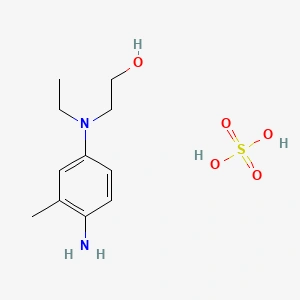
Kodak CD 4
4-(N-ethyl-N-2-hydroxyethyl)-2-methylphenylenediamine sulfate (CAS 25646-77-9), is a white to off-white crystalline powder that serves as the colour developing agent in modern colour negative photographic processes. It is a para-phenylenediamine derivative bearing an ethyl group and a hydroxyethyl group on one nitrogen and a methyl group on the aromatic ring, an asymmetric substitution pattern developed for the Kodak C-41 process and known in the trade as CD-4 colour developer. In the working developer it is oxidised to a quinone diimine, which then couples with the colour couplers contained in each emulsion layer to form the cyan, magenta and yellow image dyes that make up the final picture. Purity of 99 percent or higher is typical of photographic-grade material.
1. Photographic processing: the active developing agent in C-41 colour negative film and RA-4 colour paper developers, forming the cyan, magenta and yellow image dyes that together create the full colour record in the processed material.
2. Colour chemistry: oxidises to a reactive quinone diimine that couples with phenolic and pyrazolone couplers, the fundamental reaction of chromogenic colour reproduction and a central topic in dye-formation kinetics and imaging science research.
3. Laboratory and industrial applications: used in photographic chemistry, colour developer kits and replenisher formulations, and studied in sensitometry, dye stability and image permanence investigations.
4. Handling and storage: a known skin sensitiser and toxic by ingestion; store sealed in a cool, dry, dark place away from oxidising agents, avoid dust and skin contact, wear nitrile gloves and eye protection, and treat spent developer as hazardous waste.
Product Name: Kodak CD 4
For global customers, we provide complete technical documentation to support product evaluation, regulatory compliance and safe handling during transportation and application.