
LANTHANUM TRIS
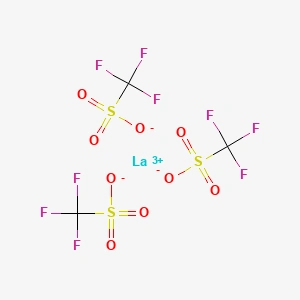
Lanthanum(III) trifluoromethanesulfonate, identified by CAS number 52093-26-2 and often referred to as lanthanum triflate, is a highly versatile rare-earth metal salt utilized extensively as a Lewis acid catalyst in organic synthesis. This compound presents as a white, crystalline, and hygroscopic solid that exhibits exceptional thermal stability and solubility in a variety of organic solvents and water. Unlike traditional Lewis acids such as aluminum chloride, lanthanum triflate is notably water-tolerant, allowing for catalytic processes to be conducted in aqueous media or under moist conditions without rapid decomposition. Its chemical identity centers on the lanthanum center coordinated to three trifluoromethanesulfonate groups, providing a strong electron-withdrawing environment that facilitates diverse transformations. In industrial and research settings, it is valued for its recyclability and mild reaction conditions, making it a preferred choice for sustainable chemistry initiatives. Proper handling requires precautions against moisture absorption to maintain its catalytic efficiency, though its inherent robustness compared to other metal triflates makes it an essential raw material for complex molecular assembly.
• Serves as a powerful and selective Lewis acid catalyst in a broad spectrum of organic transformations, including Friedel-Crafts acylations, Diels-Alder reactions, and aldol condensations. Its unique ability to function effectively in the presence of water or protic solvents distinguishes it from conventional catalysts, enabling more environmentally benign synthetic routes. By coordinating with carbonyl or hydroxyl groups, it lowers activation energy barriers, facilitating the construction of complex carbon-carbon and carbon-heteroatom bonds with high atom economy.
• Utilized in polymer science as a specialized initiator or catalyst for ring-opening polymerization of cyclic esters like lactide and epsilon-caprolactone. Its role is critical in producing biodegradable polyesters with controlled molecular weights and narrow polydispersity indices. The stability of the lanthanum center allows for precise control over the polymerization kinetics, which is vital for developing high-performance materials used in medical devices and sustainable packaging solutions.
• Acts as a key reagent in the synthesis of fine chemicals and pharmaceutical intermediates, particularly in multi-step sequences requiring chemoselective activation. It is frequently employed in the glycosylation of carbohydrates and the rearrangement of epoxides, where its mild acidity prevents unwanted side reactions common with harsher reagents. The ease of recovery from reaction mixtures allows for the reuse of the catalyst, significantly reducing the overall cost and environmental footprint of large-scale chemical manufacturing processes.
Product Name: LANTHANUM TRIS
For global customers, we provide complete technical documentation to support product evaluation, regulatory compliance and safe handling during transportation and application.