
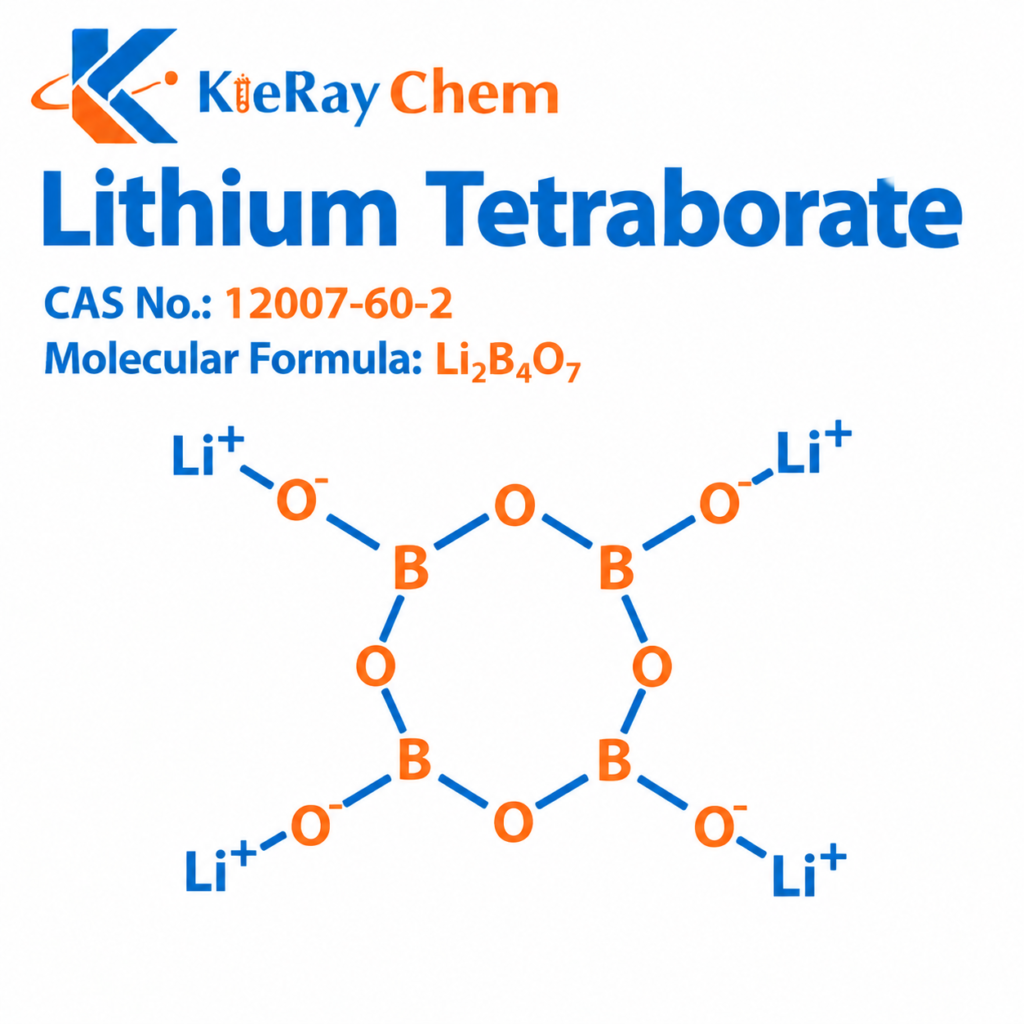
Lithium Tetraborate
Lithium Tetraborate (CAS:12007-60-2) is a lithium borate salt with strong fluxing and fusion properties. It is the standard fusion flux for X-ray fluorescence and ICP sample preparation, and a key raw material for borosilicate glass, ceramics, glazes, optical crystals and lithium borate-based materials, appreciated for its purity and consistent melting behavior. As a Industrial Grade product, this material is manufactured with defined process control and released against documented specifications covering assay, impurities and physical properties, which simplifies incoming inspection for buyers. Flexible packaging options including 25kg/drum, 25kg/bag, IBC Drum and dependable export logistics make volume sourcing straightforward, while consistent quality protects downstream process reproducibility and end-product performance.
KieRay Chem has established itself as a stable and trustworthy supplier of Lithium Tetraborate (CAS:12007-60-2), combining years of manufacturing experience with rigorous quality management. Every batch is tested against tight specifications for assay, impurities and physical properties, and complete COA, technical data sheets and safety documentation are provided with each shipment. Our flexible packaging options, dependable global logistics and responsive technical support ensure that research laboratories, formulators and industrial manufacturers receive consistent material on schedule. Competitive pricing, long-term stock availability and the ability to tailor grades and pack sizes make KieRay Chem the partner of choice for sustaining uninterrupted production and product quality.
## Lithium Tetraborate (Li₂B₄O₇, CAS 12007-60-2): Key Functions and Uses
1. **XRF Fusion Flux**
Lithium Tetraborate is widely used as a high-performance fusion flux for **X-ray fluorescence (XRF) analysis**. It helps convert powdered rocks, minerals, ores, ceramics, cement, glass, and other refractory materials into homogeneous glass beads for accurate elemental analysis.
2. **Dissolution of Refractory Materials**
During high-temperature fusion, Lithium Tetraborate can dissolve many refractory oxides, silicates, and mineral components. This reduces sample heterogeneity and improves the consistency and reproducibility of analytical results.
3. **Preparation of Glass Beads and Fused Disks**
CAS 12007-60-2 supports the preparation of stable glass beads or fused disks used in wavelength-dispersive XRF and related spectrometric workflows. Homogeneous specimens can help minimize particle-size effects, mineralogical effects, and matrix-related errors.
4. **Analytical Chemistry and Geochemical Testing**
Lithium Tetraborate is important in geological, mining, environmental, cement, ceramic, and metallurgical laboratories. It is used for the analysis of soils, rocks, ores, slags, refractories, and industrial raw materials.
5. **ICP and Sample-Preparation Research**
In selected workflows, lithium tetraborate fusion can be used to improve the dissolution of difficult inorganic samples before further analytical testing, including certain inductively coupled plasma methods. The appropriate flux ratio and preparation procedure depend on sample composition.
6. **Glass and Ceramic Manufacturing**
As a borate flux, Lithium Tetraborate can help lower melting temperatures and promote the formation of uniform glassy phases. It is therefore relevant to research and manufacturing involving specialty glass, technical ceramics, enamels, glazes, and lithium-containing materials.
7. **Radiation and Materials Research**
High-purity Lithium Tetraborate may also be evaluated in selected radiation-detection, dosimetry, optical-material, and solid-state research applications. Performance depends on crystal quality, impurity levels, composition, and processing conditions.
8. **Quality, Procurement, and Safe Handling**
When sourcing Lithium Tetraborate 12007-60-2, buyers should verify purity, trace-metal content, particle size, moisture level, fusion performance, packaging, certificate of analysis, and suitability for XRF or analytical use. Useful SEO keywords include **Lithium Tetraborate, Li₂B₄O₇, CAS 12007-60-2, XRF fusion flux, lithium borate flux, glass bead preparation, refractory sample dissolution, and analytical chemistry reagent**. Users should follow the supplier’s Safety Data Sheet and apply appropriate precautions when handling powders and high-temperature fusion equipment.
Product Name: Lithium Tetraborate
For global customers, we provide complete technical documentation to support product evaluation, regulatory compliance and safe handling during transportation and application.