
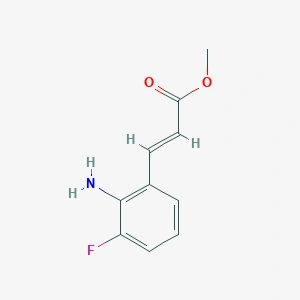
Methyl (E)-3-(2-amino-3-fluorophenyl)acrylate
Methyl (E)-3-(2-amino-3-fluorophenyl)acrylate, identified by CAS number 690664-20-1, is a specialized organic building block characterized by its cinnamate backbone, an ortho-amino group, and a fluorine substituent on the aromatic ring. This compound serves as a versatile intermediate in complex molecular assembly, offering multiple reactive sites for further chemical transformation. Its structural configuration, particularly the (E)-stereochemistry of the acrylate moiety, makes it a valuable precursor for the synthesis of diverse heterocyclic frameworks.
In a laboratory and industrial context, this chemical is handled as a fine chemical intermediate. Its physical properties typically align with substituted aromatic esters, requiring standard precautions for organic synthesis reagents. Researchers value this compound for its ability to introduce a specific fluorinated aromatic motif into target molecules, which is often a critical strategy in medicinal chemistry and materials science to modulate electronic properties and metabolic stability.
• As a key synthetic intermediate, this compound is frequently utilized in the construction of fluorinated heterocyclic ring systems, such as quinolines and indoles. The proximity of the amino and acrylate groups facilitates cyclization reactions, allowing for the efficient synthesis of complex scaffolds used in the development of bioactive molecules.
• The presence of the fluorine atom at the 3-position of the phenyl ring provides a strategic handle for medicinal chemistry research. Fluorine substitution is a common technique used to improve the lipophilicity and metabolic resistance of potential drug candidates, making this acrylate derivative an essential tool for structure-activity relationship studies.
• In the field of agrochemical development, Methyl (E)-3-(2-amino-3-fluorophenyl)acrylate serves as a precursor for the synthesis of specialized crop protection agents. Its unique substitution pattern allows for the fine-tuning of biological activity and environmental degradation profiles, contributing to the creation of more effective and targeted agricultural chemicals.
• The acrylate functional group enables this molecule to participate in various palladium-catalyzed cross-coupling and Heck-type reactions. This reactivity makes it a flexible component in the total synthesis of natural products and the design of advanced functional materials where precise control over molecular geometry and electronic distribution is required.
Product Name: Methyl (E)-3-(2-amino-3-fluorophenyl)acrylate
For global customers, we provide complete technical documentation to support product evaluation, regulatory compliance and safe handling during transportation and application.